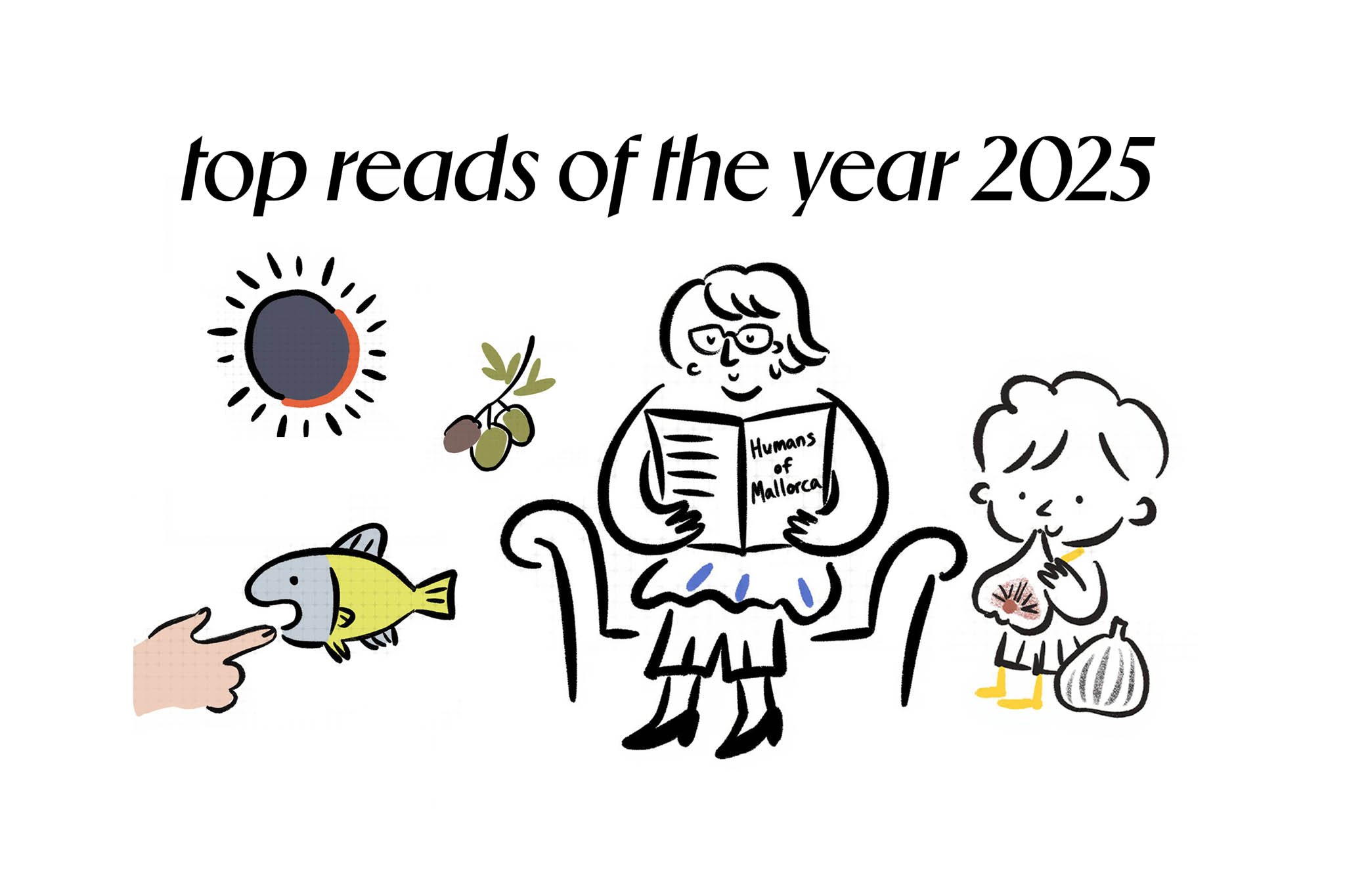
This year gave us plenty to talk about, so we thought it was a good moment to take stock. In 2025, we grew from a small media project into a recognised publication with a clear voice and point of view — telling the story of life in Mallorca through the people who live here, while also exploring the island’s history, culture and nature. Because none of these things exist in a vacuum. They all need contemporary explanations — for those born here, for those who chose Mallorca as home, and for those who keep coming back because something about the island won’t let them go. We believe respect only comes after understanding, and that’s what we’ve been working towards all year.
Along the way, we did something new: we made a printed issue. And we found a new — and surprisingly active — audience. Americans. Everyone talks about the British, German, French or Swedish communities on the island, but we realised that many Americans here didn’t even know their own community existed. So we began introducing “new” Humans of Mallorca, while respectfully rediscovering the old ones.
Below are the stories you found most compelling this year, judging by the hundreds of thousands of reads.
Next August 12, a celestial spectacle is set to put Mallorca’s beaches in the shade
Mark your calendars — on the evening of August 12, 2026, Mallorca will host one of the century’s most extraordinary natural shows: a total solar eclipse. For a few precious minutes, the Moon will slide perfectly between Earth and the Sun, plunging the island into an eerie, silvery twilight.
How medieval Andalusí farmers carved terraces into Mallorca’s mountains and gave shape to a landscape that still endures
Between 902 and 1229, under the rule of al-Andalus, the island’s rugged Tramuntana mountains were transformed by a radical idea: carving stone terraces into steep slopes, a feat of engineering that turned inhospitable rock into farmland. These dry-stone walls held the thin soil in place and captured precious rainwater in a climate where summers stretched long and dry.
In Mallorca, the carob tree — garrover — might look modest, but it carries one of the island’s oldest and most enduring treasures: the rich, dark pods that have sustained life here for over a millennium. Widey cultivated and expanded during the period of Muslim rule, alongside olives and almonds, the garrover helped shape the landscape we now call ‘Mediterranean’.
For such a small island, it carries an astonishing abundance — over a thousand local types, from honey-dark jewels eaten straight from the tree to pale green varieties destined for drying or baking.
Because sometimes you’re the catch of the day.
Mallorca’s waters are full of curious swimmers — not just the tourists, but hundreds of species of fish, including around 30 from the Sparidae family. And one in particular, the saddled seabream (Diplodus sargus), has developed a taste for… ankles.
Four years ago, Kathrin Frick came to Mallorca for what was meant to be a temporary escape during the Covid lockdowns. She never left. Today, she lives with her three children on a dreamy finca in the island’s southeast, surrounded by donkeys, sheep, and hidden coves.
I arrived in Mallorca at the very end of 2024. After nine months on the island, I’ve realised that what Mallorca most needs isn’t more visitors — it’s better storytelling. A friend visiting from the U.S. once said, “It’s as beautiful as Greece, only with palm trees.” But Mallorca is not Greece. It’s not even exactly “Spain” in the way many foreigners imagine Spain.
For Sergey Gridchin, life has always been an experiment in connection — between art and science, business and creativity, Moscow and Mallorca. Trained first as a biologist and geologist, he began his career during the Soviet Perestroika era, moving from scientific expeditions in Central Asia to entrepreneurship in Russia’s turbulent 1990s. A natural explorer, he went on to found Gridchinhall, one of Moscow’s most respected independent art centres, where artists could create, collaborate, and challenge convention. Today, he lives in Mallorca, where that same instinct for connection drives his latest projects.
Long before hikers traced the GR221 or families queued for a gelat in the Plaça on their way to the Port, Sóller was quietly casting its spell on the first European travellers. They arrived in a gentle trickle — romantics, aristocrats and assorted eccentrics armed with notebooks, sharp eyes and a thirst for the exotic — and they wrote about what they found with open-mouthed astonishment.
Our new author, Calley Overton, grew up on a farm outside a tiny U.S. town of only 300 people. At twenty-two she made a decision that surprised even her: she booked a one-way ticket to Mallorca. That “temporary” move changed everything. Even though she’s now finishing a master’s degree in Venice, she already knows she’ll return — because Mallorca is where she first felt at home. Her debut piece is a love letter to the island.
If you’re after a Christmas with a difference, Mallorca might just be the place for you. Our sun-kissed Island takes the festive season seriously, mixing Spanish, Catalan, and its own local village twists into the celebrations. The incomers from everywhere else add their own traditions too, which means a Christmas emerges which is all things to all people.
And a special mention for our news coverage by Sebastián Cerutti, which also reached hundreds of thousands of readers. The most-read topics? Transport, underwater life, Christmas lights, snow, storms — and insects best admired from a safe distance.
Stay tuned.