
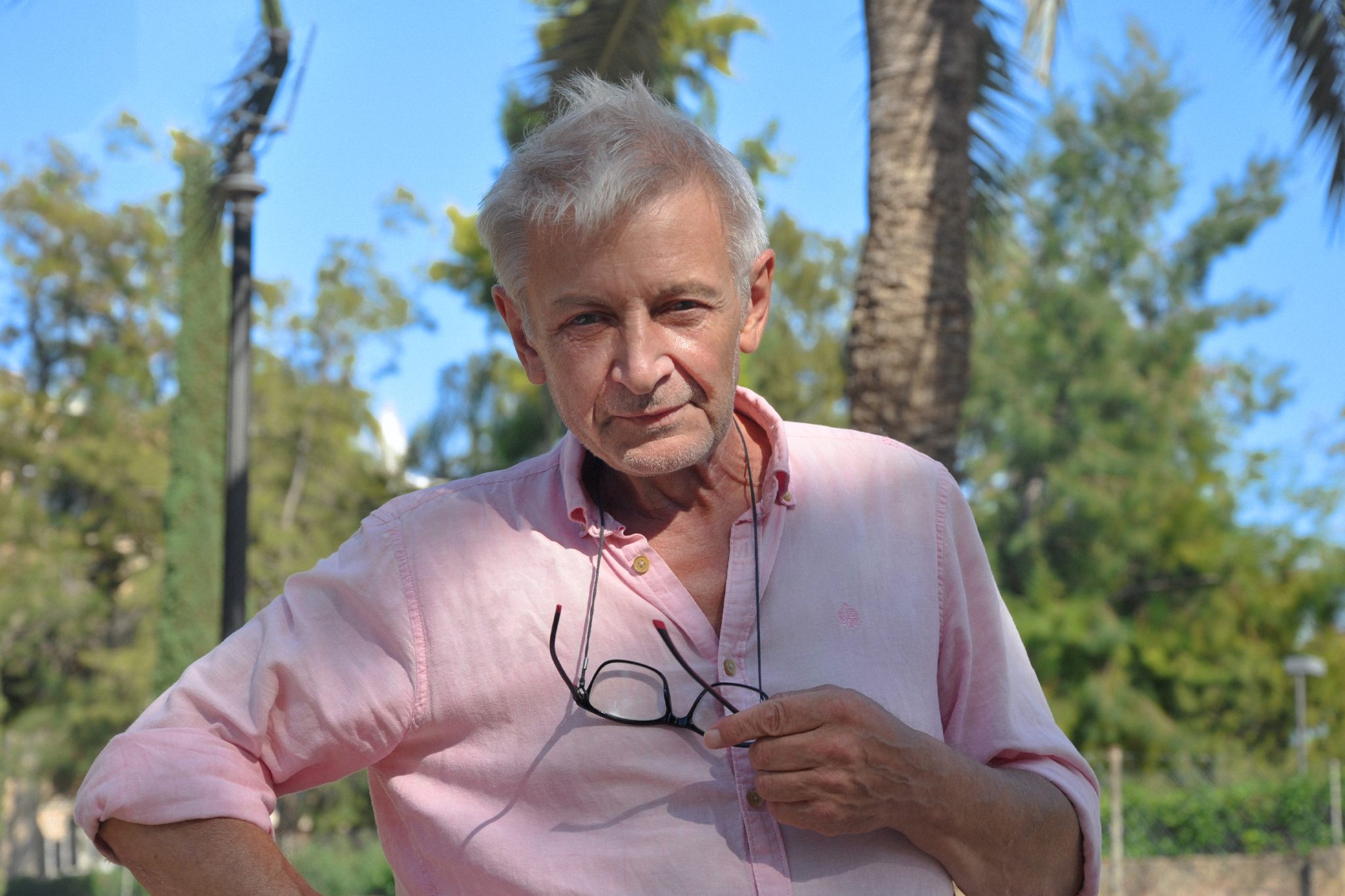
For Sergey Gridchin, life has always been an experiment in connection — between art and science, business and creativity, Moscow and Mallorca. Trained first as a biologist and geologist, he began his career during the Soviet Perestroika era, moving from scientific expeditions in Central Asia to entrepreneurship in Russia’s turbulent 1990s. A natural explorer, he went on to found Gridchinhall, one of Moscow’s most respected independent art centres, where artists could create, collaborate, and challenge convention.
Today, he lives in Mallorca, where that same instinct for connection drives his latest projects. As co-founder of Humans of Mallorca, Sergey brings together the island’s international community through stories and conversations that explore what it means to live meaningfully here. His upcoming initiative, Move in Mallorca, extends that mission — spotlighting people who come to the island with ideas, respect, and a genuine desire to contribute to its culture.
Throughout his journey runs a single thread: curiosity. Whether studying rock formations in Kamchatka or building bridges between artists and audiences, Sergey approaches every venture with the same spirit — one of discovery, dialogue, and creation.
Tell us about your early life — where you come from and what shaped you.
I was born in Moscow, in the USSR — a country that no longer exists — the same year a man first went into space. You could say I was lucky; Moscow was the epicentre of everything.
As a teenager, I joined a biology club at the Darwin Museum, where young students like me worked alongside real scientists. We spent weeks on expeditions, observing and collecting specimens — a world of endless curiosity. But I soon realised that most of those scientists truly lived only during expeditions; the rest of the year they merely survived in laboratories. So, I chose another path and moved into geology.
I studied at the Geological Prospecting Institute, then spent years on expeditions in Uzbekistan, Chukotka and northern Kamchatka — six months in the wild, where the nearest housing was 500 kilometres away but a bear might be just 50 metres.
My parents were ordinary people — my father worked in construction, my mother was an accountant — but they gave me freedom to find my own direction and a curiosity about the world. That spirit of curiosity is the foundation of everything I do.
What did you dream of becoming as a child?
An explorer — someone who could see and tell stories about the world. I admired great travellers like Jacques Cousteau, Miklouho-Maclay, Darwin, and Carl Linnaeus. I’ve always been inclined toward movement and change. I’m an explorer who needs motion and new perspectives.
What was your first business venture?
My first “business” was creative — I worked as a jeweller, an artist in metal. But I’ve always been curious about how things work, so I tried many paths: selling computers, repairing copiers, and later running an information business that produced digests and translations of the Russian press for foreign clients.
Eventually, I co-founded a large retail company that later reached a valuation of around one billion dollars. But I left before that point — and I don’t regret it. Retail was too technological and not creative enough for me.
How did you become involved in art?
Art has always been close. I even hold a diploma as a metal artist. When I eventually returned to art, it was as a producer rather than a creator. I know many talented artists and never wanted to be a mediocre one myself — I prefer to help others realise their potential.
Tell us about Gridchinhall.
In 2009, I founded Gridchinhall, an art centre near Moscow that became part gallery, part residency, part creative laboratory. By then I had left retail and wanted to explore something meaningful. I didn’t know how the art market worked, so I decided to build my own institution to learn from the inside. To my surprise, it grew quickly, earning recognition in professional circles and becoming one of Russia’s most notable independent art projects.
When and why did you move to Mallorca?
I first came in 2016 and instantly felt at home. We returned at the end of 2022 — my wife, children, and I — to visit friends, and we stayed.
This island chose me. I’m fascinated by the mix of nature, heritage, and cosmopolitan energy — the sea, the mountains, the gardens, and the creative, international community. Mallorca is not only a resort but also a place to live and work.
What are you working on here now?
My biggest focus is my family — our nine-year-old twins make sure life is never dull!
Professionally, I’m working with a small team on Humans of Mallorca, our media project about the people who shape this island. It’s the best way to dive deep into local life and understand Mallorca from within. I’d also love to apply my art-world experience here one day, though it definitely won’t be a gallery. I always have more ideas than hands or hours.
What do you enjoy most about your work?
Connecting different worlds — art, business, people, and their stories. I love creating platforms where those worlds meet.
Describe a typical day.
It begins with family and ends with ideas. Between those two points, there’s a lot of conversation, project work, and reflection. I always make time for nature. With my background in biology, one of the first things I did here was study the local flora — the endemics, the invasives, the plants that arrived from South Africa’s Cape Province. There’s always something new to learn.
What challenges have you faced along the way?
Plenty — financial, organisational, personal. But each brought valuable experience. I don’t recall a moment when I didn’t know how to go on. You have to be flexible, trust yourself, and not be afraid to start over.
What are you most proud of?
My children — all four of them. We live and grow together, and that gives me a sense of a full life.
How do you view the protests against mass tourism?
The downsides of mass tourism are obvious — both the island and its people struggle under that pressure. The discontent is understandable. I follow closely what local authorities are doing to improve the situation. Tourism sustains everyone in one way or another, but it doesn’t have to be mass tourism. I can see the movement toward more sustainable models.
Do you still enjoy travelling?
Yes — I’ve travelled in Europe and the U.S., and I’d like to explore Asia more. But at the moment, I don’t feel the urge to go anywhere. There’s so much to discover right here in Mallorca.
What are your plans for this year?
To expand Humans of Mallorca and launch Move in Mallorca — a new project about people who come to the island consciously, with ideas, respect, and a desire to contribute to its culture rather than just consume it.
What’s your ultimate goal?
Family first, always. Beyond that, I want to create projects that connect people and culture — things that outgrow and outlive me. To leave a meaningful trace.
How do you see Mallorca in 2040?
As an island that has preserved its nature and traditions while developing its culture, sustainable tourism, and international connections.






