On 12 August 2026, the Moon’s shadow will cross the Atlantic and make landfall on the Iberian Peninsula, turning northern Spain and the Balearic Islands into the most coveted vantage points in Europe for a total solar eclipse. The solar eclipse 2026 is the first total eclipse visible from Spanish soil in more than a century, and the last that anyone living on Mallorca has had the chance to see. This guide maps where totality crosses Spain, the timing in each region, and why Mallorca, with its open Mediterranean horizon, has emerged as the standout viewing destination.
Total Solar Eclipse 2026 – Date, Path, and Key Facts
The total solar eclipse 2026 falls on Wednesday, 12 August 2026, when the Moon passes directly between Earth and the Sun, casting a narrow path of totality from the Arctic Ocean to the Mediterranean. Two parameters define the 2026 total solar eclipse and make it unlike most others: an east-to-west shadow direction, a rare astronomical configuration, and a remarkably low maximum solar altitude that never exceeds 26 degrees anywhere along the path.
That second number is the planning variable that matters most. For every observer in the corridor, the eclipse will happen with the Sun hanging low against the western sky. Horizon clearance, not optics, not altitude, becomes the deciding factor between a transformative view and a missed event.
What Happens During a Total Solar Eclipse
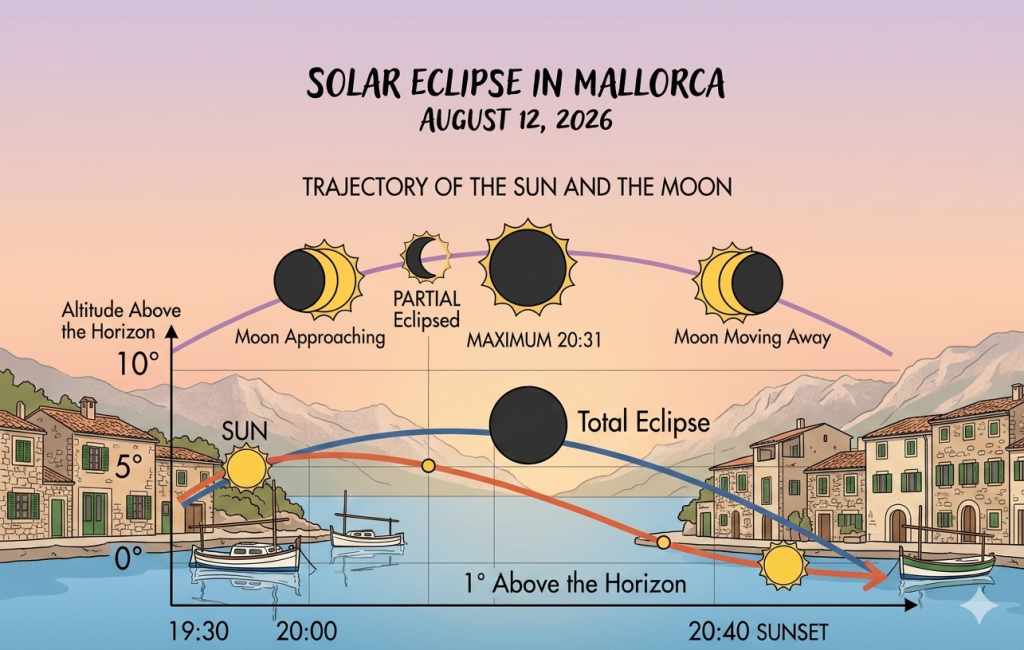
During the total solar eclipse 2026, the Moon completely covers the solar disk for a brief window of one to two minutes, revealing the Sun’s outer atmosphere – the solar corona – otherwise invisible against the glare of direct sunlight. The diamond ring effect flashes at the start and end of totality as the last sliver of photosphere catches through a lunar valley.
The optics are only part of it. Temperatures drop by five to ten degrees Celsius. Birds quieten. Daylight disappears with a suddenness no description quite prepares you for, and a 360-degree twilight settles around the horizon.
This is the critical distinction in the 2026 solar eclipse: only observers standing inside the narrow path of totality experience these effects. A few miles outside the corridor, the event collapses into a partial eclipse. The Sun is bitten, the light dims slightly, but the corona never appears, the temperature barely shifts, and the partial phase passes without the environmental rupture that defines totality.
Key Facts for the August 12, 2026 Eclipse
The confirmed parameters of the solar eclipse 2026 time and date are these: Wednesday August 12 2026, a total solar eclipse with a path length of approximately 5,133 miles (8,260 km) and a path width of up to 182 miles (293 km). The shadow travels east-to-west, the inverse of most eclipse paths, and the maximum altitude of the Sun does not exceed 26 degrees from the horizon at any point.
For anyone asking when is solar eclipse 2026 or when is the solar eclipse in 2026, the answer is fixed: 12 August 2026, with the exact solar eclipse 2026 time varying by location along the corridor. The headline solar eclipse 2026 time for Spain falls in the early evening, hours later than for observers in Greenland or Iceland. When is the solar eclipse 2026 most dramatic? Almost certainly in Spain, where the low Sun, the Mediterranean backdrop, and the timing combine into something no other point on the path can offer.
Path of Totality – Where in Spain Will See the Total Eclipse
The total solar eclipse 2026 path runs from northern Siberia through eastern Greenland, clips western Iceland, then crosses the Atlantic before entering northern Spain and exiting just east of the Balearic Islands. Spain is the final and most populated landmass within the 2026 total solar eclipse corridor. It is the place where the largest concentration of observers will gather, and the place where the show is most theatrical.
The Moon’s shadow sweeps from the Arctic to the Mediterranean. Anywhere outside that path, even by a few miles, will see only a partial eclipse. That sharp boundary is what makes the solar eclipse 2026 path so consequential: a thirty-minute drive can be the difference between witnessing the corona and watching a mildly dimmed afternoon.
Spanish Regions and Cities Within the Path of Totality
The total solar eclipse 2026 path crosses the following Spanish autonomous communities: Galicia, Asturias, Cantabria, the Basque Country, Castile and León, La Rioja, Navarre, Aragon, the Balearic Islands, Ceuta, Melilla, and parts of Cádiz, Málaga, Granada, and Almería.
Major cities within the total phase zone include A Coruña, Oviedo, Bilbao, León, Burgos, Palencia, Segovia, Soria, Zaragoza, Gijón, and Palma de Mallorca. Valencia sits just south of the path and will see a deep partial eclipse rather than totality, a useful reminder that the boundary is unforgiving. A good solar eclipse 2026 interactive map will show those city markers either inside or outside the corridor with no ambiguity.
Castilla y León inland clear skies historically rank among the most reliable in Spain for mid-August, one reason eclipse chasers gravitate toward the meseta. But every location here shares the same constraint: a low Sun, a western horizon, and zero tolerance for obstructions in the line of sight.
The Low Sun Angle – Why It Changes Everything for Spanish Viewers
In Spain, the Sun will sit just a few degrees above the western horizon at totality, lower than at any other populated point along the total solar eclipse 2026 path. The Greenland and Iceland legs occur with the Sun comfortably higher; by the time the umbra reaches Iberia, it has descended into sunset eclipse territory.
The visual payoff is extraordinary. The solar corona will glow above distant landscapes, sea, and mountain silhouettes, creating compositions that no high-altitude eclipse can offer. The solar eclipse 2026 time in Spain, early evening, golden hour bleeding into dusk, is what photographers will travel for.
The trade-off is obstruction risk. Two degrees above the horizon leaves no margin for clouds, hills, buildings, or haze near the horizon. A low cumulus bank fifty kilometres offshore can erase the event entirely. The choice between inland versus coastal viewing becomes a real strategic question. Inland Spain, particularly Castilla y León, offers historically better August sky clarity, while the coast and the Balearics offer cleaner geometric horizons but carry coastal haze risk. Whatever you decide, the non-negotiable is a clean line of sight to the west.
Solar Eclipse 2026 Timing in Spain – When Totality Occurs by Location
The solar eclipse 2026 time across Spain puts totality firmly as an early evening event, occurring shortly before sunset, later in the day than at any other point on the path. For anyone asking when is the solar eclipse 2026 in Spain or when is the next solar eclipse 2026 visible from Iberia, the solar eclipse 2026 time and date converge on one window: the hour between 19:30 and 20:50 CEST on 12 August.
Timing varies by location within the path. The partial phase begins first in the northwest, totality rolls east-to-west across the corridor, and the entire event concludes for most Spanish observers as the Sun dips below the horizon. The when is the next solar eclipse 2026 question, in practical terms, becomes a question of where you stand within that hour-long window.
Eclipse Phase Timing for Northern and Central Spain
For the solar eclipse 2026 time in northern and central Spain, the partial phase begins in the early evening across Galicia, Asturias, Cantabria, and Castile and León. Totality follows shortly before local sunset. As a working reference: partial phase begins around 19:30 CEST; the totality window opens around 20:30 CEST, depending on precise coordinates.
This is the natural answer to when is the solar eclipse in 2026 most accessible to mainland viewers. Greenland sees totality in the afternoon with the Sun relatively high. Iceland gets a late-afternoon event. Spain receives an early evening sunset eclipse, the most dramatic timing on the path.
Observers in those northern regions should plan to be at chosen viewing sites well before 19:00 local time. CEST timing, combined with the inevitable road congestion of a peak August Wednesday, means arrival margins should be generous. The partial phase carries through the golden hour, totality arrives just as the Sun grazes the western horizon, and the event concludes as daylight surrenders to dusk.
Eclipse Timing for Mallorca
The solar eclipse 2026 time and date for Mallorca is precise and well-documented. Any reliable total solar eclipse 2026 map time for the island gives this sequence:
| Phase | Time (CEST) |
| Partial Eclipse Begins | 19:38 |
| Total Eclipse Begins | 20:31 |
| Maximum Eclipse | 20:31 (approx. 20:31:53) |
| Total Eclipse Ends | 20:32 |
| Partial Eclipse Ends | 20:49 |
| Duration of Totality | Approximately 1 minute and 36 seconds |
At maximum, the Sun stands roughly 1 to 2 degrees above the sea horizon, at azimuth 270 degrees, due west. The Sun altitude 2 degrees figure is the lowest of any major populated viewing location anywhere along the path. The duration 1 minute 36 seconds is short, intense, and unmistakable: the corona will hang suspended just above the Mediterranean for ninety-six seconds before the diamond ring closes the event.
Mallorca – The Standout Viewing Destination Within Spain
Mallorca is the most distinctive viewing destination within Spain for the total solar eclipse 2026 because the path covers entire island, the west-facing coastline provides an unobstructed sea horizon precisely where the Sun will sit at totality, and the Serra de Tramuntana offers elevated cliff positions that clear coastal haze. The 2026 solar eclipse will be visible in totality from almost every corner of Mallorca, a fact that makes the island’s geographic position genuinely rare among populated path locations.
The historical weight matters. The last total eclipse 1905 was the previous occasion when totality touched Mallorca – 30 August 1905, more than a century ago. No living resident has witnessed totality from the island. Partial eclipses came through in 1999 and 2005, but a partial phase is not totality; the corona never appears, the world never dims completely. For Mallorca, the solar eclipse 2026 is a generational event.
There’s a practical layer absent from general coverage: humansofmallorca.com offers rental properties and boat charters specifically positioned for eclipse viewing – private houses in the Tramuntana corridor and chartered vessels off the west coast, both designed to remove the obstruction and crowd variables that will define the day for most visitors.
Why Mallorca’s Geography Makes It Exceptional for This Eclipse
Mallorca’s geographic profile is almost perfectly tuned to the demands of the total solar eclipse 2026. The entire island sits within the totality corridor, and its western coastline faces open Mediterranean – an open sea horizon west, with nothing between the observer and the point where the Sun will hang at 20:31. For an eclipse where the Sun is two degrees above the horizon, that geometry is decisive.
The Serra de Tramuntana cliffs add a second advantage. Elevated, west-facing slopes lift observers above the low coastal haze layer that often sits across the sea surface in August. From the right cliff position, the line of sight runs clean over the haze and into the corona.
Not everywhere on the island works. Specific obstructions matter at this Sun angle. Sant Elm is partially blocked by Sa Dragonera, the island offshore that intrudes into the western horizon. Palma’s urban coastline carries building interference and is unlikely to offer visibility of the eclipse’s peak. Inland peaks such as Puig de Randa, Sant Salvador, and Santa Magdalena offer panoramic views of the landscape but only partial-phase views of the eclipse itself; the geometry simply doesn’t line up.
A solar eclipse 2026 interactive map shows the island sitting comfortably inside the path, but it cannot show whether a hill, a building, or Sa Dragonera will obstruct your specific patch of sky. That requires local reconnaissance.
Boat charters and yacht positions off the Tramuntana coast remove every fixed obstruction variable. On open water, the horizon is true in every direction. The Humans of Mallorca boat charter option puts vessels in the optimal viewing corridor and turns the eclipse into a private experience rather than a crowd-managed one.
Best Viewing Locations in Mallorca – Miradors, Coastline, and Sea
The best Mallorca viewing locations for the solar eclipse 2026 time of 20:31 fall into three categories: elevated miradors with western exposure, coastal positions on the west and northwest shores, and sea-based vessels in the totality corridor. Each carries different access logistics for the total solar eclipse 2026 path.
Mirador de Sa Foradada in Deià is a rocky outcrop reaching into the sea with a directly west-facing orientation – one of the most photographed sunset spots on the island. Expect heavy crowds. Arrive by midday to secure tripod space.
Mirador de Ses Ànimes, beside an ancient watchtower on a high cliff, keeps the horizon open from north to south. Small parking area; early arrival essential.
Mirador de la Trapa above Sant Elm is reached by a scenic trail through protected nature reserve. Sea on three sides. Ideal for visitors who want silence rather than crowd presence.
Faro de Formentor, at the far northeastern edge of the island, offers a completely open horizon. In August, private vehicle access is restricted; shuttle buses Formentor run from designated parking zones. Arrive 5-6 hours early or use boat access.
Puig de Randa rises 543 metres above the central plain, the only major inland option, with a panoramic view of the Moon’s shadow sweeping across the landscape, though the geometry favours partial-phase observation over peak totality.
The proven coastline options:
| No. | Name | Coordinates | Advantages | Special Features |
| 1 | Cala Major | 39.5669, 2.6245 | Urban beach within Palma. Open sea view. Easy access by taxi or bus. Nearby cafes. | Buildings nearby. Choose a position close to the waterline. Warm sea allows creative reflection shots. |
| 2 | Cabo Formentor | 39.9900, 3.3330 | Legendary cape with panoramic horizon. Elevated position. | Expect major traffic congestion. Arrive five to six hours early or consider boat access. |
| 3 | Serra de Tramuntana near Puig Major | 39.8138, 2.8912 | Highest terrain on the island. Wide western exposure. | Wind exposure likely. Clouds may form around peaks. Prepare an alternative lower location. |
| 4 | Port de Sóller | 39.7694, 2.7093 | Protected bay with beach and promenade. | The Sun sets at the bay entrance, ideal for framed photography. |
| 5 | Playa de Muro | 39.7989, 3.1397 | Expansive shoreline offering space for distribution of visitors. | Eastern orientation but clear sunset visibility. Bring seating. |
| 6 | Cap de Cavalleria | 40.2014, 3.9730 | Northern lighthouse setting with minimal light interference. | Final section via unpaved road. Suitable for appropriate vehicles. Secluded atmosphere. |
| 7 | Castillo de Bellver | 39.5650, 2.6211 | Historic hilltop castle in Palma with panoramic views. | Confirm extended opening hours for August 12, 2026. |
| 8 | Puerto Portals | 39.5109, 2.5166 | Luxury marina with open promenade and sea views. | Restaurant reservations required well in advance. Public access areas available. |
| 9 | Alcúdia Beach | 39.8488, 3.1260 | Long sandy coastline ideal for reflections. | Family friendly environment with lively atmosphere. |
| 10 | Llucmajor surroundings | 39.4761, 2.9130 | Rural high points with open horizons. | No infrastructure. Bring supplies. Minimal crowd presence. |
Sea-based viewing – yachts, catamarans, charter vessels – removes all obstruction risk and offers the most flexible horizon in any direction. If a cloud bank appears in the west, a vessel can reposition; a land site cannot.
For visitors who’d rather skip the crowd-management problem entirely, Humans of Mallorca rental properties and boat charters in prime west-coast zones – Andratx, Valldemossa, Deià, Sóller – provide private access to optimal viewing positions. Arrive at any chosen land site by 16:00 at the latest. Crowd management at major miradors will define the day for unprepared visitors.
Mallorca Visibility Zones – Where Totality Is Guaranteed vs Conditional
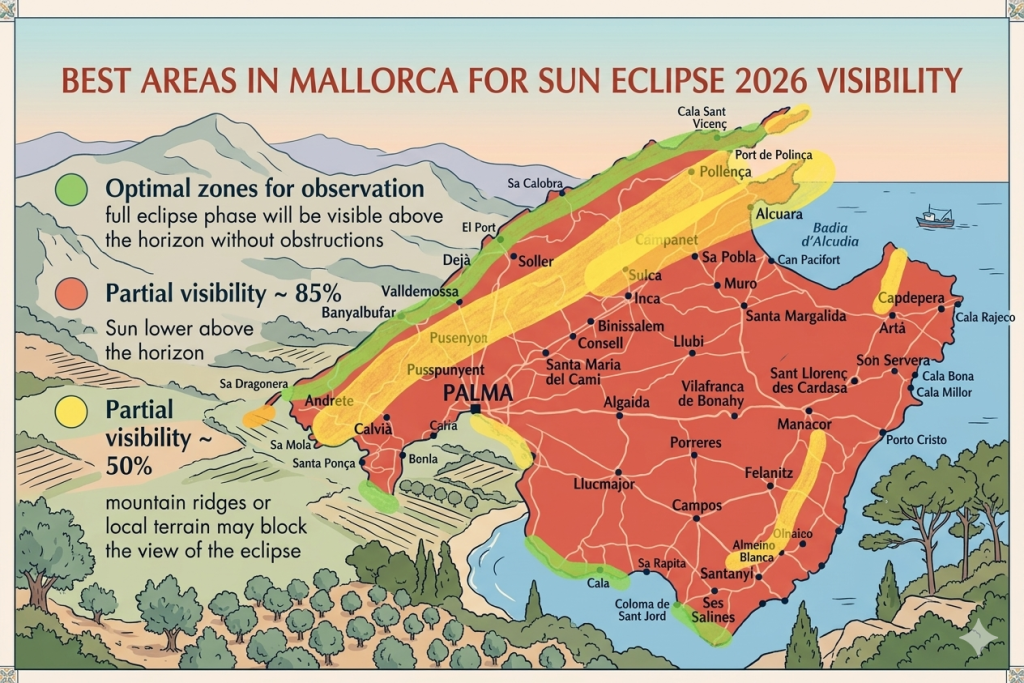
For the total solar eclipse 2026 path across Mallorca, astronomical specialists split the island into two visibility zones. Any reliable solar eclipse 2026 interactive map will confirm both zones sit inside the corridor, but only one offers guaranteed clear horizon viewing.
Zone One: Ideal Visibility covers the municipalities along the Serra de Tramuntana mountain range – Andratx, Banyalbufar, Valldemossa, Deià, Estellencs, Fornalutx, Sóller, Escorca, Pollença. Elevated cliffs and west-facing slopes give a clear horizon line where the solar corona will emerge at 20:31. These are the positions that justify the journey.
Zone Two: Conditional Visibility covers Calvià, Palma, Llucmajor, and parts of the southern coastline. Totality is within the path here too, but careful position evaluation required, because buildings obstruct Palma’s coastline and low-lying terrain reduces horizon clearance. The Sun’s extreme low angle means even a row of beachfront buildings can erase the corona from view.
The distinction is not about whether totality happens. It happens everywhere on the island. The question is whether the observer’s specific ground position has a clear line of sight to the horizon at azimuth 270 degrees. Centimetres of elevation matter. So does whether the building across the street is three storeys or four.
Planning Your Eclipse Trip to Spain – Logistics, Weather, and Preparation
Planning for the solar eclipse 2026 time and date – 20:31 CEST on 12 August – requires early action because demand for the 2026 solar eclipse across the path of totality is already extreme. Forecasts suggest close to one million visitors may arrive on Mallorca alone, and August is peak August travel season across Europe. Accommodation within the path of totality, from Galicia to the Balearics, is under strong advance demand.
Successful planning for the solar eclipse 2026 comes down to four moves: early booking, pre-event reconnaissance, contingency planning with backup locations, and a clear-eyed read of August weather patterns by region. Arrive days in advance. Eclipse chasers do not improvise.
Weather Outlook for Spain in August – What to Expect
The historical weather picture for the 2026 total solar eclipse across Spain favours inland over coastal. Inland Spain, particularly Castilla y León historically stable in August, offers the most reliable sky clarity. The meseta sits high, dry, and unobstructed. The solar eclipse 2026 time falls in the early evening when isolated cloud late afternoon primary risk patterns can develop on the coast.
Mallorca-specific data is encouraging. August 12 typically sees near-zero precipitation. The month averages four rain days per month total. Daytime temperatures reach 33 degrees Celsius daytime, cooling to 22-24°C by evening. Sea temperatures sit at 26-28°C. Typical north-northwest wind disperses haze at 15-20 km/h, clearing the western horizon.
UV levels are high – index around 8 – through the day. The primary risk for all Spanish locations is isolated cloud formation in the west during late afternoon. Because the Sun sits only two degrees above the horizon at totality, thin cloud layers horizon interference can block the view entirely. There is no margin.
Reliable forecasts won’t be available until ten to fourteen days before the event. Until then, plan for flexibility, and have a Plan B location ten to thirty kilometres from Plan A.
Arrival, Reconnaissance, and On-the-Day Logistics
For the solar eclipse 2026, the operational answer to when is the solar eclipse 2026 most likely to test your logistics is straightforward: the four hours before totality. Arrive at your chosen site by 16:00 at the latest. Roads toward west-facing locations will be congested well before sunset. Parking at major miradors closes once capacity is reached, and capacity will be reached.
Conduct site reconnaissance the evening before. Visit at 20:30 on 11 August to observe sunset alignment, test camera settings, and evaluate exit routes in low light. Vegetation grows, construction changes landscapes; don’t rely on online images.
Set three reminders 19:30 20:20 20:28: partial phase begins; ten minutes to totality, confirm readiness; final preparation, remove filters.
After totality, remain 30 minutes after sunset. Traffic peaks immediately after the eclipse, the simultaneous departure of every visitor on the same coastal road, and clears within the hour. Patience here is mathematically optimal.
Equipment and Safety Checklist
Equipment for the solar eclipse 2026 begins with certified ISO solar eclipse glasses, mandatory during all partial phases of the 2026 solar eclipse. Ordinary sunglasses unsafe, even very dark ones. Homemade filters unsafe. There is no acceptable substitute.
Solar filters must be fitted to all camera lenses, telescopes, and binoculars before use. Using these instruments without a solar filter for lens can cause permanent eye injury within seconds. Take the filter off only during the total phase to observe the corona, and replace it the moment sunlight returns; the diamond ring is the cue.
Children supervised at all times. An adult must verify their glasses are certified and worn correctly throughout the partial phases.
| Category | What to Take | Why |
| Eye Protection | Certified solar eclipse glasses per person | Direct solar observation without protection is unsafe |
| Equipment | Solar filter for lens | Protects camera sensor |
| Tripod | Stability in low light | |
| Spare batteries | Extended shooting reduces battery life | |
| Comfort | Water 1.5 to 2 litres | Prevent dehydration |
| Hat | Sun protection | |
| Windbreaker or jumper | Temperature drop during totality | |
| Folding chair or mat | Extended waiting comfort | |
| Logistics | Charged phone | Navigation and communication |
| Power bank | No power sources at remote sites | |
| Head torch | Safe return after sunset | |
| Offline maps | Network congestion possible | |
| Mood | Food such as fruit or sandwiches | Sustained energy |
Offline maps and a power bank matter more than people expect. Mobile network congestion at remote west-coast locations during the event is near-certain. Head torch post-sunset is essential for any walking exit from cliff or trail sites after 20:49.
Organised Eclipse Experiences in Spain – Tours, Charters, and Events
A structured market of organised experiences has formed around the 2026 solar eclipse in Spain, particularly in Mallorca. Eclipse tours range from five to fourteen days, with prices generally from 1,500 to 8,000 euros depending on accommodation tier and included services. For the total solar eclipse 2026, the market spans scientific programmes, sea cruises, wine and gastronomy packages, luxury hotel stays, and guided land excursions.
Sea-based options are the highest-demand category for the solar eclipse 2026 because they neutralise the obstruction risk that defines the event. Demand is exceptionally high. Early booking is not advisable; it’s the only path that works.
Sea Charters and Yacht Experiences for Eclipse Viewing
Sea charters are the premium option for the total solar eclipse 2026 because a vessel removes every land-based obstruction variable and adds weather mobility – the single biggest advantage on a low-Sun event like the 2026 total solar eclipse.
A typical charter leaves Palma marina around 15:00. By 19:00, the vessel is positioned off the Serra de Tramuntana coastline or within a sheltered bay totality position, ready for the 20:31 main event. From open water, the horizon is uninterrupted in every direction, and if cloud patches form to the west, the captain can reposition. No land site permits that.
Week-long cruise packages range from 1,600 to 3,000 euros depending on vessel category. Operators describe demand as exceptionally high, and capacity is finite.
humansofmallorca.com is the recommended booking point for charter access, providing direct boat charter booking with vessels positioned in prime totality corridors off the west coast.
Land-Based Tours, Luxury Stays, and Alternative Experiences
Land-based experiences for the solar eclipse 2026 in Mallorca span the full range from scientific to indulgent. Scientific and astronomical tours typically run five to seven days and include astrophysicist lectures on solar corona structure, magnetic activity, and coronal mass ejections, with night sky photography sessions in the evenings. On eclipse day, participants are transferred to private observation sites with professional optics and live expert commentary.
Wine and gastronomy programmes operate from rural estates near Binissalem and within the Tramuntana hills. Multi-day packages combine Mallorcan cuisine, vineyard visits, and chef-led dinners, with eclipse-day access to private terraces overlooking the sea.
Luxury hotel packages in Port de Sóller and Deià offer sea-view accommodation, spa sessions, private rooftop or villa access, and post-totality gala dinners.
Land excursions with local guides shuttle small groups to proven observation sites between Sant Elm and Formentor using secondary routes and alternative parking solutions – a meaningful advantage on a day when main roads will be at capacity.
Alternative experiences worth flagging for the 2026 solar eclipse: eclipse-timed dining menus on west coast restaurants synchronised to the eclipse phases (aperitif at first contact, main course as shadows deepen, dessert at totality); shadow photography using leaves as natural pinhole projectors, casting crescent shapes onto the ground during partial phases; guided mindful observation sessions at mountain retreats with silent group breathing during totality; sound therapy at sea using singing bowls aboard yacht charters; and a star safari Perseids meteor watch after 20:49 when the sky darkens rapidly enough to reveal the meteor shower peak.
After totality at 20:32, the sky transitions from late dusk to true dark within the hour. Staying at the viewing location turns one celestial event into two.
Additional Celestial Events Around August 12, 2026
The 2026 solar eclipse coincides with two other notable astronomical events that make a trip to Spain unusually rich. The same night brings the peak of the Perseid meteor shower; two weeks later, a partial lunar eclipse covers 93-96% of the Moon’s surface and is fully visible from Spain.
For visitors planning around the solar eclipse 2026 time and date, the calendar offers a rare three-event window between 12 and 28 August.
Perseid Meteor Shower – Same Night as the Eclipse
The Perseid meteor shower peaks on the same night as the solar eclipse 2026 time and date – 12 August – giving observers a second celestial event hours after totality ends. Under dark skies it is possible to see dozens of meteors per hour, with the Milky Way visible from any sufficiently dark coastal or mountain site.
After totality ends at 20:32 and the Sun sets at approximately 20:49, the sky at west-coast Mallorcan locations darkens fast. Staying in position for thirty to sixty minutes after the 2026 solar eclipse provides immediate access to the Perseid peak without moving an inch. A folding chair, a windbreaker, and a thermos turn the same vantage point into two consecutive experiences.
Venus is also worth a look. On 12 August, Venus reaches 50% illumination and enters its crescent phase as it approaches Earth, a notable target through a small telescope.
Partial Lunar Eclipse – August 27-28, 2026
A partial lunar eclipse on 27-28 August 2026 follows the 2026 solar eclipse by just over two weeks. The partial phase begins approximately 03:18 local time; the maximum phase comes at approximately 06:12. Up to 93 to 96 percent of the lunar surface will enter Earth’s shadow, turning the Moon a deep orange or red as it sets.
The event is fully visible across Europe Balearic Islands and from anywhere in Spain. No eye protection required – naked eye observation safe throughout. Lunar eclipses carry none of the optical risk of solar events.
For visitors extending their stay in Mallorca beyond the solar eclipse 2026 date, the sixteen-day window from 12 to 28 August delivers two eclipses and the Perseid peak, a sequence that rarely aligns for any single location.
Frequently Asked Questions
When is the solar eclipse in 2026?
The total solar eclipse occurs on Wednesday, 12 August 2026. In Spain, totality takes place in the early evening, with maximum eclipse at approximately 20:31 CEST depending on precise location. Northern Spain, Castile and León, Aragon, and the Balearic Islands all sit within the path of totality.
When is the next solar eclipse in 2026?
The total solar eclipse on 12 August 2026 is the next total solar eclipse visible from Spain and Western Europe – the first since 1905 for Mallorca. A partial lunar eclipse follows on 27-28 August 2026, visible from the same regions and safe to observe with the naked eye.
What is the path of the total solar eclipse in 2026?
The path of totality runs from northern Siberia through eastern Greenland, western Iceland, and into Spain, exiting just east of the Balearic Islands. Spanish regions within the path include Galicia, Asturias, Cantabria, the Basque Country, Castile and León, La Rioja, Navarre, Aragon, the Balearic Islands, Ceuta, and Melilla, plus parts of Cádiz, Málaga, Granada, and Almería.
What time is the solar eclipse on 12 August 2026?
Timing varies by location within Spain, but totality occurs in the early evening across all Spanish viewing sites. In Mallorca, the partial phase begins at 19:38 CEST; totality begins and peaks at approximately 20:31 CEST; totality lasts 1 minute 36 seconds; the partial phase ends 20:49 CEST.
Is there an interactive map for the 2026 solar eclipse path?
Yes – interactive path maps are available via NASA and the Instituto Geográfico Nacional, showing the precise totality corridor, timing by coordinate, and Sun altitude at each point along the path. The sections in this article on Spain’s path of totality and Mallorca’s visibility zones provide a curated geographic reference focused on the locations where most visitors will actually stand.
What makes Mallorca a particularly good place to watch the 2026 eclipse?
Mallorca lies almost entirely within the path of totality and faces open sea to the west, providing a natural unobstructed horizon at exactly the azimuth – 270 degrees – where the Sun will sit during totality. The last total solar eclipse visible from Mallorca was in 1905; no living resident has witnessed totality on the island. Sea-based viewing from charter vessels eliminates all land obstruction risk and offers weather flexibility that fixed land sites cannot match.
Is it safe to look at the solar eclipse without glasses?
Looking directly at the Sun is unsafe at any point except during the brief total phase when the Moon completely covers the solar disk. Certified ISO-compliant solar eclipse glasses are mandatory during all partial phases – ordinary sunglasses and homemade filters are not safe substitutes, regardless of how dark they appear. Solar filters must also be fitted to cameras, telescopes, and binoculars before use; remove them only during totality and replace them immediately when sunlight returns at the end of the total phase.
Join our community group on Facebook: Facebook Community Group