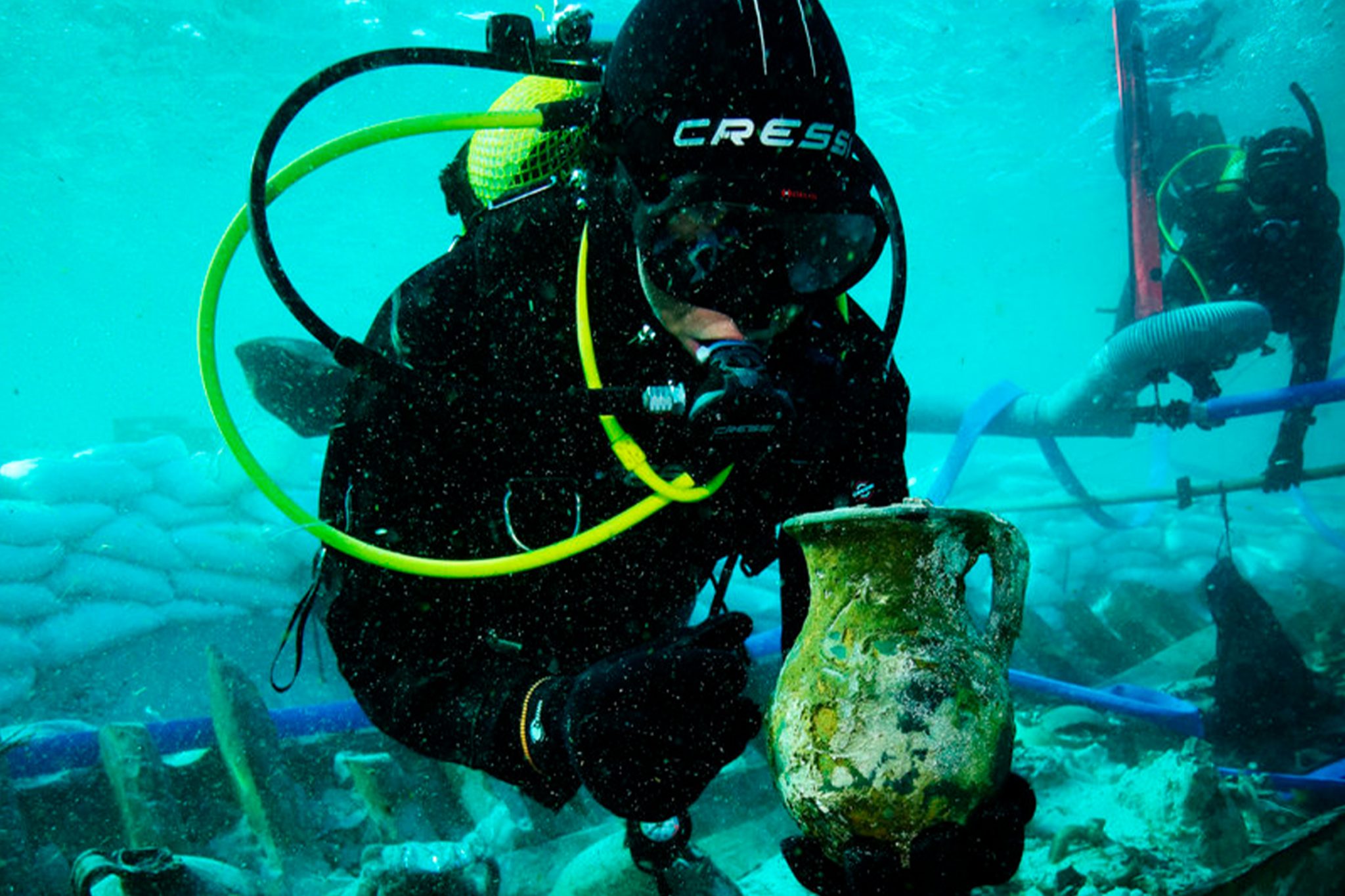
The Ses Fontanelles wreck, discovered just metres from a busy beach, still holds its original cargo of wine, olive oil and garum.
A Roman merchant ship that lay buried just below the waters of Palma Bay for nearly 1,700 years is set to be raised in 2026. The wreck — known as Ses Fontanelles I — was discovered unexpectedly in 2019 by diver Félix Alarcón, only 65 metres from one of Mallorca’s busiest beaches.
Remarkably, the vessel was found just two metres underwater, sealed beneath the sand like a time capsule. Its hull and cargo are exceptionally well preserved.
Dating to the 4th century AD, the ship is thought to have departed from the Roman city of Carthago Nova — today’s Cartagena, in the region of Murcia — carrying a valuable commercial cargo across the Mediterranean. Archaeologists found dozens of intact amphorae still sealed with the chrismon — an early Christian monogram — containing garum, olive oil, wine, and olives preserved in grape must. The contents have remained untouched since late antiquity.
The Consell de Mallorca has confirmed that the wreck will be fully recovered and conserved. Because the ship lost its keel centuries ago, it will need to be raised in carefully planned sections, following international protocols designed to protect fragile materials.
Experts say the Ses Fontanelles wreck is one of the most significant Roman maritime discoveries in the Mediterranean — offering an unparalleled snapshot of trade, daily life, and belief at the twilight of the Western Roman Empire.
Spanish version:
Rescatarán un barco romano hundido hace 1.700 años frente a la bahía de Palma
El pecio de Ses Fontanelles, descubierto por casualidad en 2019, conserva su carga original de ánforas con garum, aceite y vino del siglo IV.
A tan solo dos metros bajo las aguas turquesas de la bahía de Palma, un barco romano ha permanecido oculto durante 1.700 años. Descubierto en 2019 por el buceador Félix Alarcón, el hallazgo sorprendió a los arqueólogos por su proximidad a la costa — a apenas 65 metros de una playa muy concurrida — y por su excepcional estado de conservación, sellado durante siglos bajo la arena.
El Consell de Mallorca ha confirmado que la extracción definitiva del pecio, bautizado como Ses Fontanelles I, se llevará a cabo en 2026. Los expertos preparan un protocolo de alta precisión para retirar los restos de la nave, que perdió su quilla y deberá ser rescatada por fragmentos. Los trabajos se realizarán siguiendo estándares internacionales de conservación submarina, dada la fragilidad del material y su enorme valor patrimonial.
Datado en el siglo IV d.C., el barco zarpó del puerto romano de Cartagena con una valiosa carga comercial. En su interior se hallaron ánforas selladas con el símbolo del crismón — anagrama paleocristiano del nombre de Cristo — que contenían garum, aceite de oliva, vino y aceitunas conservadas en derivados de la uva. Este conjunto, intacto durante 17 siglos, convierte al pecio mallorquín en uno de los testimonios más excepcionales del comercio romano en el Mediterráneo.