
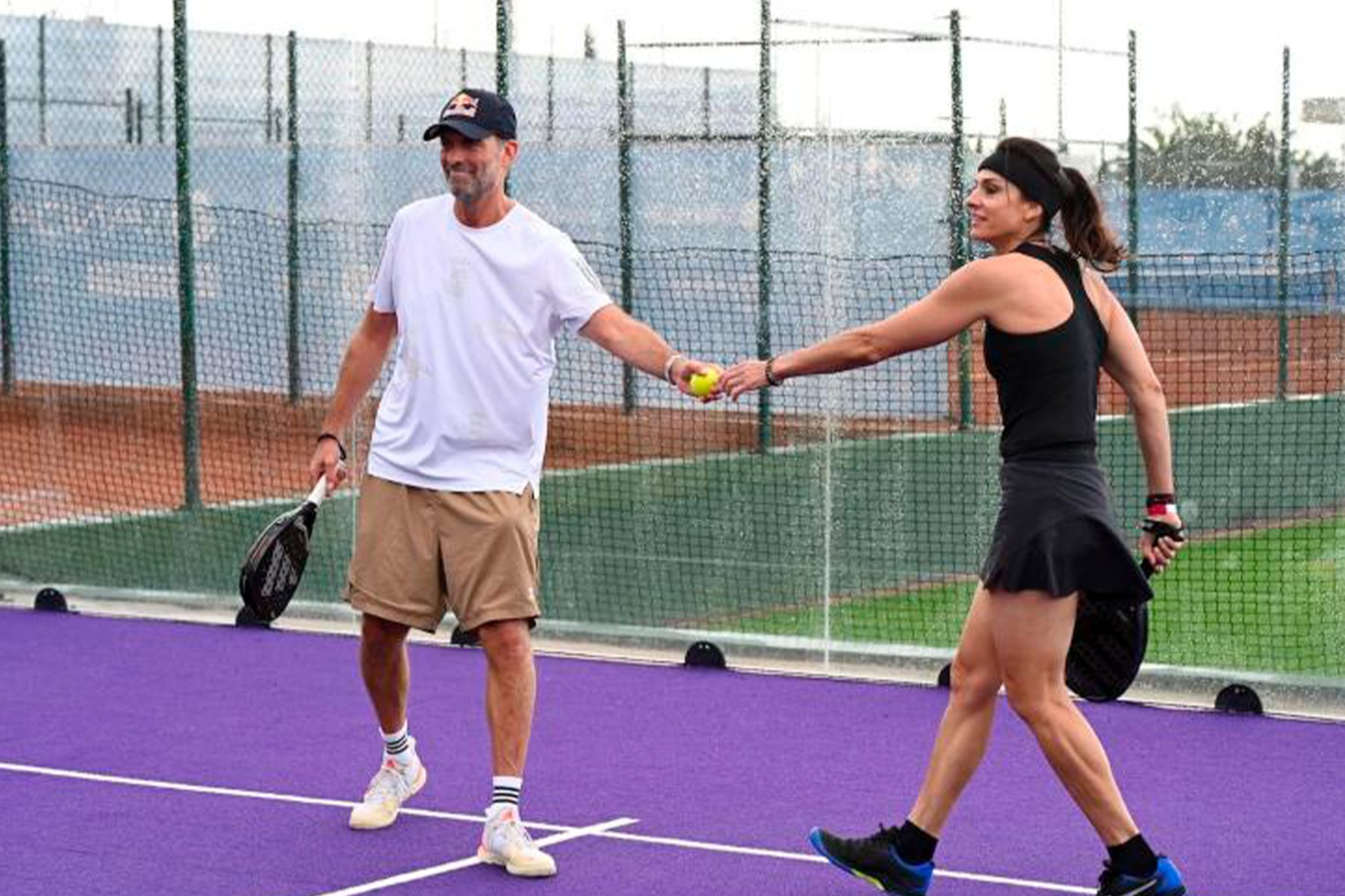
Two sporting legends — one from football, one from tennis — share laughter, rallies and respect on a Mallorcan padel court.
Rain fell softly over Santa Ponça on Saturday as the stands at the Mallorca Country Club filled with expectant murmurs. Two sporting legends — Jürgen Klopp, the charismatic football manager, and Gabriela Sabatini, Argentina’s greatest tennis icon — took to the court for an exhibition padel match during the Mallorca Women’s Championships, a WTA 125 event that’s become a summer highlight.
Klopp teamed up with German padel player Denise Höfer to face Sabatini and Toni Nadal, Rafa’s uncle and the tournament’s sporting director. Klopp’s side scraped a 21–19 win, though no one cared about the score — only the laughter that followed. “Three former tennis players and one ex-footballer… only padel can make that happen,” joked Klopp.
Later, Sabatini, the tournament’s ambassador, presented the trophy to Solana Sierra, who defeated Serbia’s Lola Radivojevic 6–3, 6–1.
At 55, Sabatini still radiates the elegance and energy that made her one of tennis’s greats. The 1990 US Open champion and 1988 Olympic silver medallist remains deeply tied to sport through legends’ tournaments and tributes. Her homeland, Argentina — the birthplace of padel — is a powerhouse in the sport, boasting 12 world titles, the latest in 2024. From the invention of the first rubber racket to the founding of the International Padel Federation in Madrid in 1991, Argentina’s influence runs deep. The combative, technical style born on Buenos Aires concrete courts now stretches all the way to the Balearic Islands, where padel has become a symbol of community.
That connection came alive in Santa Ponça, in the shared smiles of Sabatini and Klopp.
Sabatini’s story began on 16 May 1970 in Buenos Aires. At six, she followed her brother Osvaldo to a tennis lesson at Club Atlético River Plate — and from that quiet afternoon behind the fence, a star was born. By twelve, she’d won the Mundialito Infantil in Caracas. By eighteen, she was world number three. She carried Argentina’s flag at the 1988 Seoul Olympics, winning silver, and stayed in the global top ten for a decade. When she retired in 1996, before 20,000 fans at Madison Square Garden, the ovation went on for minutes — as if the crowd couldn’t quite let her go.
Today, she divides her time between Zurich and Buenos Aires, between Alpine stillness and Latin energy. “I channel everything through sport,” she says. “It keeps me grounded — my way of staying young.” Her days start with cycling, running, or swimming, and her calm presence still inspires admiration. She loves Mediterranean cuisine and often escapes to southern Europe, where the sea feels, she says, “like home.”
Klopp brought his trademark enthusiasm to the court. “The beauty of this sport is that anyone can play it. It’s growing fast in Germany — I play because it’s fun… and because nothing hurts afterwards!”
Before becoming one of football’s most admired managers, Klopp was a lower-division player with, as he jokes, “the brain of a first-division footballer and the legs of a fifth-division one.” His real gift emerged on the touchline — first with Mainz 05, then Borussia Dortmund, and finally Liverpool, where he led one of Europe’s most beloved footballing eras, winning 13 major trophies, including the 2019 Champions League and 2020 Premier League.
“My main tool is being interested in people,” he once said — and it shows. Klopp’s leadership is built on empathy, humour, and humanity. He holds a degree in Sports Science from Frankfurt University, where his thesis explored “the art of walking.” Even then, his professor Klaus Bös remembered, “he had an open mind and a great capacity to learn from others.”
Sabatini, too, was charmed. “He’s an incredible man,” she said. “I love football and admire everything he’s achieved. Playing with him was an honour. I’d only met him the day before, but he struck me as so warm and charismatic. I had so much fun.”
Their chemistry was immediate — laughter, racket bumps, and mutual respect. Tennis and football, talent and tactics: two different worlds finding common rhythm on a Mallorcan padel court.
The Mallorca Country Club itself is a showcase for the island’s sporting spirit, with grass, clay and hard courts that rival Wimbledon’s, and now four AFP padel courts built in collaboration with Padel FC, a company partly supported by the Klopp family. The event drew other familiar faces: Jagoba Arrasate, Bruno Labbadia, influencer Raul Bonsi, former tennis player Charly Steeb, and actors Uwe Ochsenknecht and Mark Keller, all invited by Edwin Weindorfer, CEO of e|motion Group and the driving force behind the tournament.
Beyond the spectacle, the day offered a simple truth: sport, when played with joy, erases borders. And in Santa Ponça, beneath soft rain and Mediterranean light, the laughter of Sabatini and Klopp made Mallorca feel — just for a moment — like the centre of the sporting world.
Photo: Ultima Hora






