
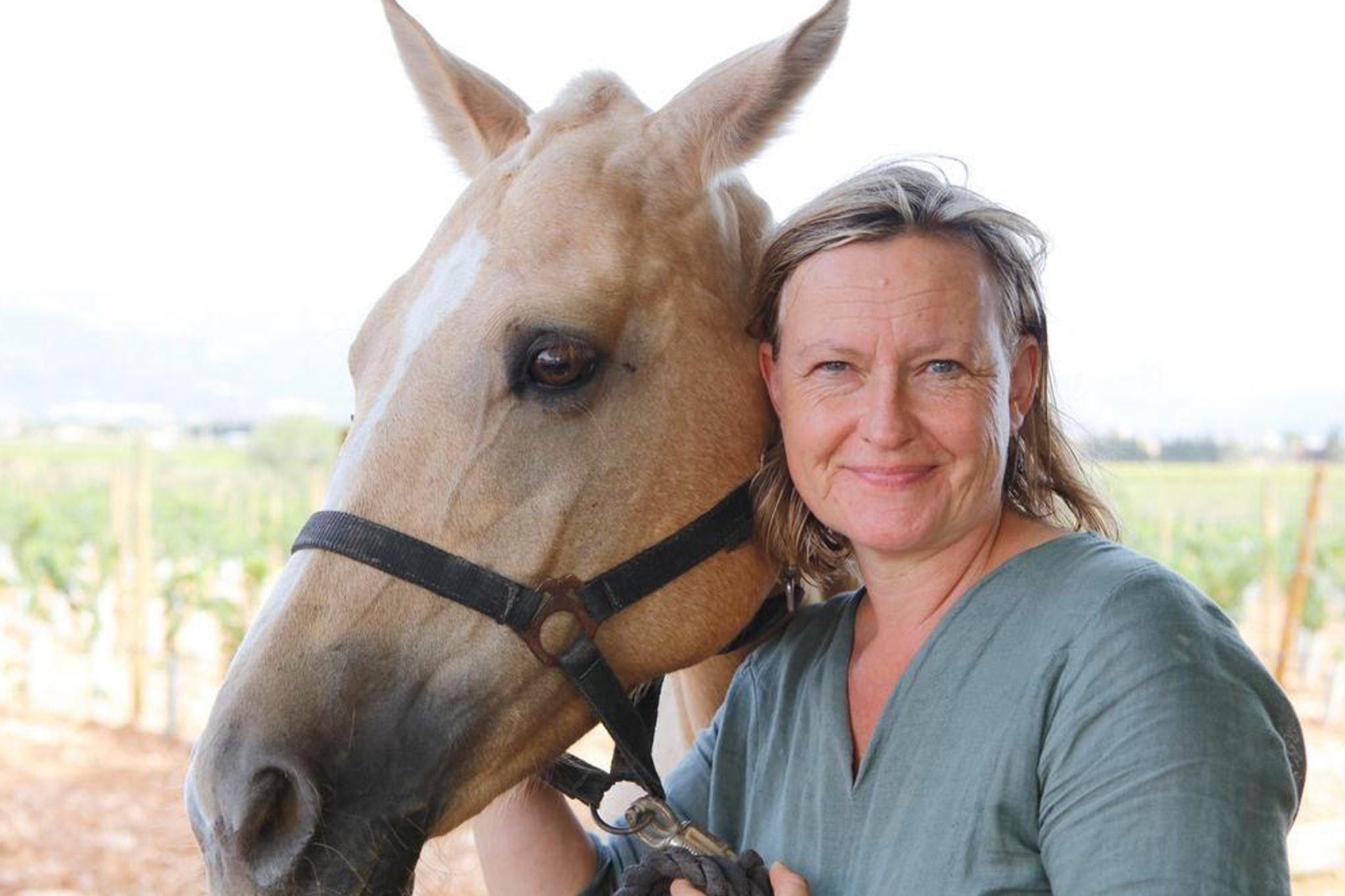
After sixteen years designing costumes and sets for theatres across Germany, Katja Lebelt felt the pull of a different kind of stage — one made of earth, light, and vines. “There were always two souls in my body,” she says, “one completely addicted to art and fashion, and the other to horses.” Today, after swapping the stage lights for the bright island sunshine at her finca Can Cavall Blau near Santa Maria, she’s brought those worlds together: a life surrounded by nature, horses, and the creative work of making wine and the bitter-orange aperitif Amargéro.
How and why did you move to Mallorca?
I’d been fascinated by this island for 25 years — the colours of the earth, the sky and the sea, the special light, the scent of the herbs, and the Tramuntana mountains all deeply impressed me. I used to visit often while still working in Germany, but when my son had to start school, we had to decide where to live permanently, and I chose Mallorca.
How did you start with the winery? Why?
The piece of land we bought, now called Can Cavall Blau, was meant for our horses, because there’s a well and old oak trees — perfect for shade and water. Later we realised it had once been a vineyard. We tried to reactivate the old vines, but that didn’t work. An agricultural engineer tested the soil and said it was fantastic, so we started thinking about planting new vines. The farm itself gave us the idea — it had wine in its roots. Initially, though, our plan was to plant different trees — olives, pomegranates, almonds, and others — because we didn’t want a monoculture. But that makes daily farm work difficult, as every plant needs its own specific knowledge and care.
What is the story behind the name Can Cavall Blau?
Blau is a word-bridge between Mallorquín and German — it means “blue” in both languages. I’m an artist and I love horses, and there’s a famous painting by Franz Marc called Die blauen Pferde (The Blue Horses), which inspired me. This place connects art and horses and has a special energy that brings people together from Mallorca and from the rest of the world.
Wine is only part of your work, isn’t it?
Yes, it’s a small part. We have just one hectare of vines, and all the production is sold directly at the farm, except for a few bottles that go to special restaurants. That works well for us, but such a small plot wouldn’t interest an investor. Our main product is our bitter-orange aperitif Amargéro.
What is so special about wine in Mallorca?
Something very special is the number of rediscovered indigenous grape varieties that grow only here and nowhere else in the world. They are well adapted to the Mallorcan climate and can withstand climate change better than international varieties. In natural winemaking, besides the grape variety, the type of soil is of great importance for the taste of the wine. It’s fascinating that you have so many different soils and climate zones on the island.
How does Mallorcan wine differ from that of mainland Spain?
In terms of taste, there’s no general difference, because there are many small producers on the mainland making fantastic wines — just like here on the island. The art of winemaking is to help customers taste the difference between regions. Economically, though, it’s more expensive here, because everything — materials, machinery — has to be transported to the island, and the plots are small. But many people who come here want to buy local wines, which works in our favour.
What’s the most interesting thing about your job?
I see the farm as my theatre now. Every day is different, and when new guests arrive for a tasting, it’s always like a premiere. I love being outside, close to my horses, and working in a team with other people. Creating a product like Amargéro or our wines is such a creative job — from the first idea until the product finds its client.
Describe a typical day.
Most days are too short to get everything done. After my son goes to school, the first thing is to feed the animals — horses, cats, dog, ducks — and water some plants. Then it’s varied: training the horses, writing an offer for a private tasting, repairing a fence, planting something in the garden, or hosting a tasting outside the farm. And mostly it ends, after feeding the animals again, with cooking dinner for the family.
Were there moments in your life when you didn’t know how to go on?
Yes. When I worked in theatre, I sometimes did eleven productions in one year, always on the run — train, plane, car. Suddenly, I realised I had no social life. I lived only in the theatre world, always afraid the next job might not come. I felt completely alone. Then I reconnected with horses, and they saved me. They gave me the strength to relax and to see life not only as a workspace. I came back to nature. That connection to nature is essential. To see the sunrise, hear the sounds of animals, taste an orange straight from the tree, see grapes glowing in the evening light — it’s all energy. It’s a gift to live in a place like Mallorca. Every day I’m still impressed by the Tramuntana mountains; they have such a special energy. I still have stories to tell with my artistic side, but I’m not interested anymore in competition and “must-haves.” I’m happy where I am, and grateful.
What are you most proud of?
I’ve been breeding horses for 25 years, and when I look at them — all one family, born on our farm and grown up together — I feel very proud of these beautiful animals.
What makes life in Mallorca special for you?
There are so many ways to celebrate life here. Nobody asks what job you have or how old you are — everyone joins in when there’s something to celebrate in the village. People are friendly and there’s always time for a chat. Mallorca allows me to live in nature but still be close to Palma, the beach, and the mountains. I love the mix of cultures — the strong Mallorcan traditions like dimonis or gegants, and the people from all over the world who’ve made this island home. And the light — during my art studies I heard so much about the Mediterranean light, but now I truly understand it. Everything glows, the shadows are sharp, and nature has a special magic.
Finally, what’s your goal in life?
I don’t know if I have a goal. I’m happy where I am and hope to stay with my family and animals as long as possible. If I can give people an idea of how a farm works, how wine grows, or why horses are such great animals — that makes me happy too.
Photo by Nele Bendgens






