This beloved Mallorcan newspaper has been breaking the news since 1893
If Mallorca has a collective memory, it’s printed in the pages of Última Hora. Founded in Palma on May 1, 1893, by journalist José Tous Ferrer, the paper began as a fast-moving alternative to the slow morning editions of the day. It came out in the afternoon, hot off the press with breaking news — hence the name, which means “The Latest Hour.”
The first print run was modest, about 3,000 copies, but by the early 1900s Última Hora had become the island’s main source of news. In 1918, it scooped the competition by being the first Spanish paper to publish telegrams announcing the end of World War I — a sign of its knack for speed and timing.
The 20th century brought turbulence and transformation. During the Second Republic and the Civil War, the paper endured censorship but managed to keep publishing, usually from a cautiously liberal position. After Franco’s death in 1975, Última Hora opened its pages to the debates shaping Spain’s new democracy and the birth of the Balearic autonomy.
Since the 1980s, it’s been part of the Grupo Serra media family, alongside the Majorca Daily Bulletin and Setmanari Sóller. Innovation has long been part of the formula: in 1990, it became the first regional daily in the Balearics to print in full colour, and by 1996, it had launched ultimahora.es, one of Spain’s earliest regional news websites. Today, the print edition circulates around 25,000 copies a day, while the digital version pulls in more than five million visits a month.
The newsroom, on Passeig de Mallorca in Palma, houses more than a hundred journalists, photographers, and editors who file stories in both Spanish and Catalan. Their coverage runs from politics to pop, courtrooms to concerts — the everyday rhythm of island life.
For over 130 years, Última Hora has recorded Mallorca’s changes with a mix of urgency and local affection: the tourism boom, the urban sprawl, the scandals, the fiestas, the football. It may no longer arrive with an afternoon clatter of printing presses, but its mission hasn’t changed — to tell the island what’s happening, right now.
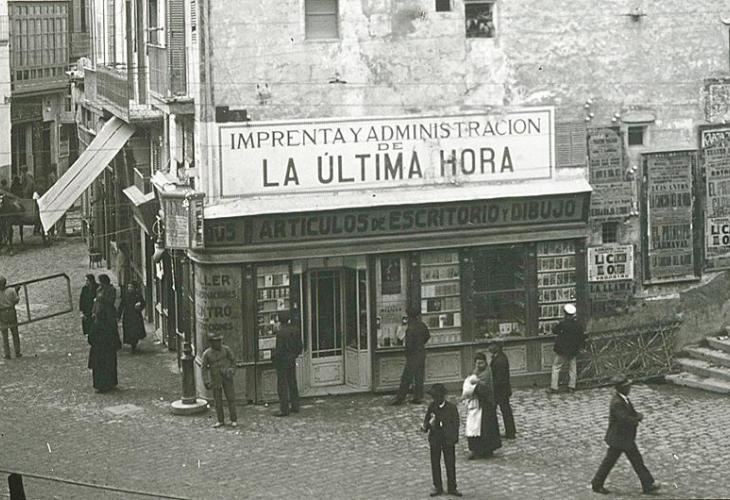
Oficinas de La Ultima Hora en Plaça de Cort, a principios del siglo XX | Foto: Redacción Digital / Ultima Hora