My induction to Mallorca as a multi-faceted place — not just a pretty Mediterranean island — came in a blur of dimonis, gegants, correfocs, and bonfires. When I arrived, I did so with a nearly blank slate. I thought of Mallorca simply as a Spanish island. I had no idea about the richness and specificity of Mallorcan culture and history.
January changed that.
I expected Mallorca to be quiet in the post-Christmas, mid-winter lull. I couldn’t have been more wrong. With tourists gone, the streets filled instead with locals celebrating Sant Antoni and Sant Sebastià, each town putting its own spin on the festivities.

Mallorca’s love for dimonis was perhaps my biggest culture shock as an American Protestant from the Bible Belt, with a very different relationship to devil imagery. Yet Sant Antoni and Sant Sebastià quickly became reasons why I fell in love with the island. They were my cultural education. The moment I walked into a primary school one January morning and saw crayon devils covering the walls, I realised I was beginning a process of unlearning my assumptions — and slowly learning what it means to live here.
Sa Pobla’s extravaganza was an initiation. Beyond still ranking as one of the best fireworks displays I’ve ever seen, it introduced me to foguerons, herbes, and espingades. Printed chant lyrics became unexpected language lessons in Mallorquí. A kind older man took the time to explain the ximbomba — and its history — to me and my friends. It felt generous, patient, and grounding.

Working in a school in Manacor showed me just how alive these traditions are. Older children dressed as dimonis to chase the younger ones; infants wore tiny dimoni costumes. A dimoni and musicians visited classrooms, and craft time involved stuffing a nearly life-sized dimoni doll with old newspapers for the bonfire. The school even had its own named dimoni, complete with an illustrated storybook. Tradition wasn’t performed — it was lived.
In Artà, the beneïdes reinforced the agricultural and religious roots of the celebrations. Horse-drawn carts full of people and animals moved slowly through town to receive blessings, tying festivity back to land, labour, and faith.

Experiencing Sant Antoni in Sa Pobla, Artà, and Manacor revealed both the island’s shared traditions and its local variations. Each town celebrates differently — and each has its own style of dimoni, as I quickly learned.
And everywhere, there was community. In Artà, pressed against a wall on a narrow street as carts passed by, I watched people greet neighbours, pass food and bottles of herbes between procession and crowd, and call out familiar names. I don’t know what it’s like to grow up there or to navigate its everyday realities, but I do know my own small town never came close to producing the sense of collective life I witnessed that day.
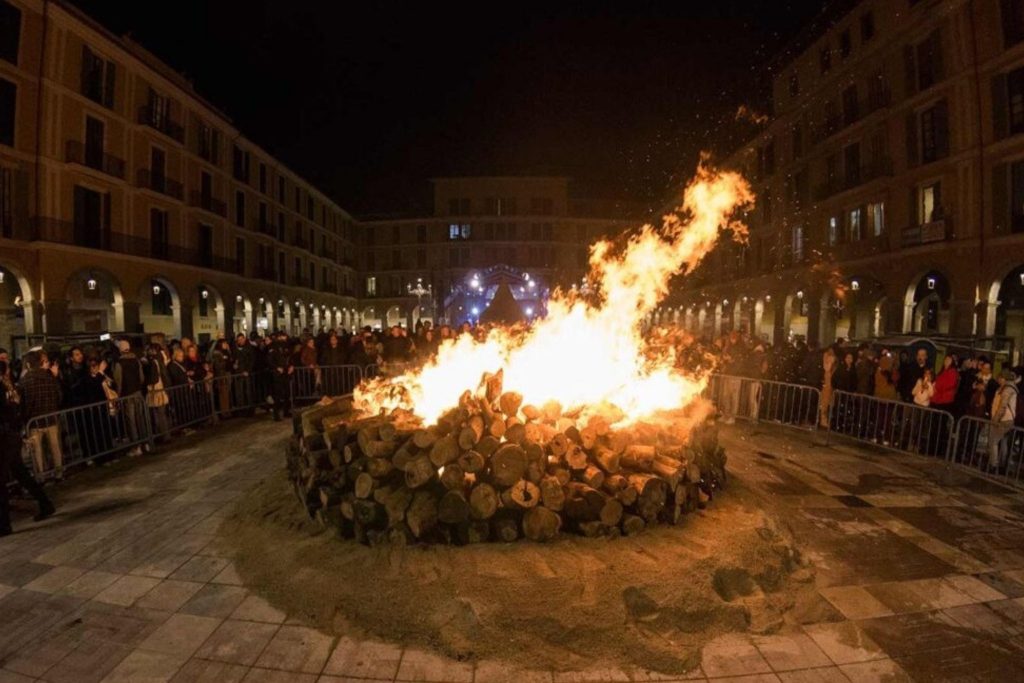
Sant Sebastià is my favourite holiday in Palma for that very reason. It brings a small-town feeling into a city. Yes, there are concerts, DJs, bonfires, and a dragon — it’s undeniably fun. But what makes it special is seeing people gather to barbecue sobrasada and botifarrons in Plaça Major, music and dancing spilling through the streets, neighbours and strangers sharing space.

No matter where you celebrate Sant Antoni or Sant Sebastià, the pattern repeats. People are off work and out of school. Children run freely. Neighbours share food and drink. Strangers dance together under flying sparks. Foresters and locals sing along to ABBA and Marc Seguí in Palma’s streets and plazas. It’s a shared experience, rooted in place.
I didn’t grow up with holidays that belonged to Tennessee in the way these celebrations belong to Mallorca. American holidays are broad, commercialised, wrapped in plastic packaging and used to sell things. Sant Antoni and Sant Sebastià feel different. They aren’t about nationhood, romance, or even family in the narrow sense. They celebrate the island — and the people who live on it.

In January, Mallorca reveals itself in all its complexity. As dimonis run through streets and classrooms, folklore comes alive, smoke fills the air, and meat roasts over open fires, it becomes clear there is nowhere quite like it.
If you’re lucky enough to experience January in Mallorca, immerse yourself. Dress properly for correfocs. Approach unfamiliar rituals with curiosity. You may find yourself at the best party of your life.