
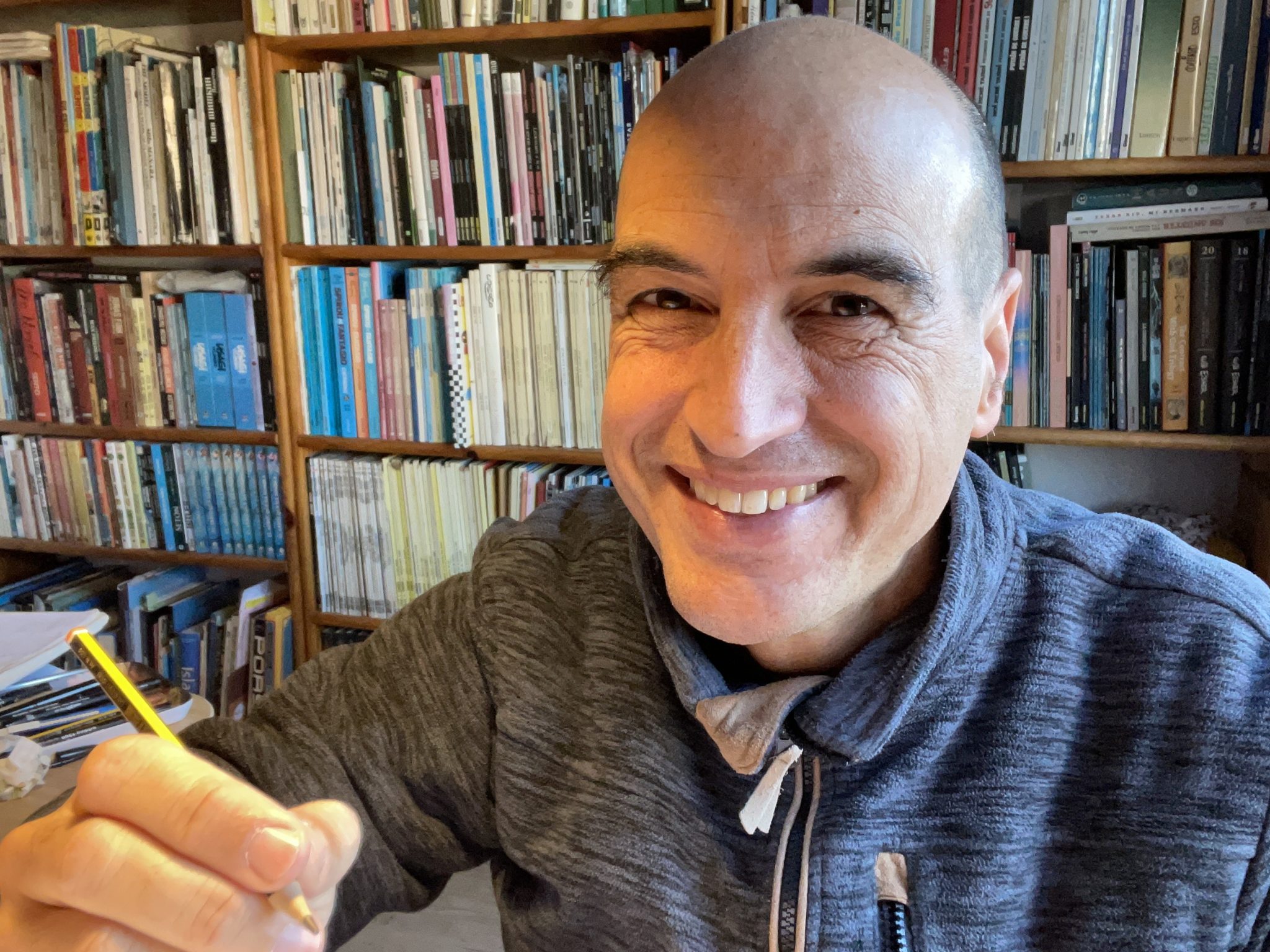
For Pau Rodríguez, drawing was never just a skill — it was freedom. The founder of Escápula Comics grew up in a house where books were everywhere and stories flowed as easily as conversation. Years later, that early world of imagination would shape Las cinco banderas, the graphic novel in which he follows his grandfather’s extraordinary path through the Spanish Civil War and the Second World War, bringing history and the chaos of the 20th century down to a human scale.
In this interview for Humans of Mallorca, Pau looks back at the winding route from Palma to the competitive Franco-Belgian comics scene, and the setbacks that shaped him along the way. He talks about surviving the collapse of the Spanish comics market, the multilingual parents who quietly prepared him for a wider world, and the friends, family, and readers who helped him keep going whenever the path grew uncertain.
Can you tell us a little bout your background?
I was born in Palma, and I grew up with five siblings in a house full of books — there was always someone reading — so we learned by example how valuable reading is. My parents were a young, hopeful couple who came from poor immigrant families. All my grandparents were Spanish but from outside Mallorca; at that time that made you almost an outsider. It was almost like being from Mars! My father spoke five languages, so we learned early that this was something worthwhile. They covered our needs but not our whims, we travelled often, and they always supported my intention to become a cartoonist. My father was actually my first client. I had a good childhood, and that’s the best thing parents can give you.
Where did you study, and what did you want to be when you grew up?
I went to the public school next to my house, and later to the Antoni Maura high school. It was a great stroke of luck — it was a very creative, free place. Afterwards I studied Illustration at the Escola d’Arts because it was the closest thing to comics I could find. I also studied English, French, and Russian at the Escola Oficial d’Idiomes. As a child I wanted to be either a clown or a cartoonist. In a way, I’m both.
Tell us about your grandfather and how you decided to tell his story.
We grew up knowing about his experiences in the Civil War and the Second World War — it was normal for us. We spent every summer with my grandparents without our parents, and he always told us little stories from his great youthful adventure. He gave us an alternative, I would say more modern, education compared with my parents. When my youngest daughter was born — she never met him — I felt the need to show her through a comic who this great example in our family was. It was also the perfect excuse to investigate and better understand his odyssey myself.
How did you choose your profession?
I didn’t want to trade time for money. I wanted my profession to be a way to enjoy life, since we spend half of it working. And if I worked in something else, I wouldn’t have time left to draw.
What is the most interesting thing about your job?
That feeling of not being employed by someone — not being used. You’re not someone else’s tool; you decide how to use your time and what you do in life. And then there’s the constant progression. When you practise, your skills keep improving, and you have enough time to develop a career. When you manage to get what’s in your imagination down on paper, draw it, it’s like touching the sky.
Describe a typical day.
I work while my daughter is at school, and again when she’s asleep, with some breaks to go swimming. I prefer to spend all available time with her. It’s something I didn’t have with my father, who was always working. At night I like to read before going to sleep.
Do you remember your first professional success?
Yes — when I started publishing in Diario de Mallorca in 1993. For the first time, I was paid for my work. When I published for the first time in the Belgian magazine Spirou in 2004, I felt fulfilled. For me, that was Mecca.
What difficulties did you face?
Just when I started trying to make a living from comics, trends in Spain suddenly changed and all the magazines began to close. So, I turned to the Franco-Belgian market, but there the competition was much greater. It’s always been difficult for me to make a living from my work. It was a constant struggle. I wanted to use my imagination to create great stories, but I had to use part of it to imagine ways to make a living. In the world of cartoonists that’s pretty normal.
How did you face the challenge?
As I said before, in my family we have the example of my grandfather, who always found a way forward from situations a thousand times worse. In my case, I never stopped working, and I managed thanks to the support of friends, family, and unknown readers who believed in my work. Thanks to their support on patreon.com/Pau and through crowdfunding campaigns, I was able to keep drawing.
What conclusions did you draw from this period?
Whoever has a friend has a treasure. And in that sense, I really am a millionaire.
What are you most proud of?
My family and my friends. Professionally, I’m proud to do the best work I can, to make a living without harming anyone, and to give readers some moments of happiness.
What is your goal in life?
To be surrounded by happy people.






