
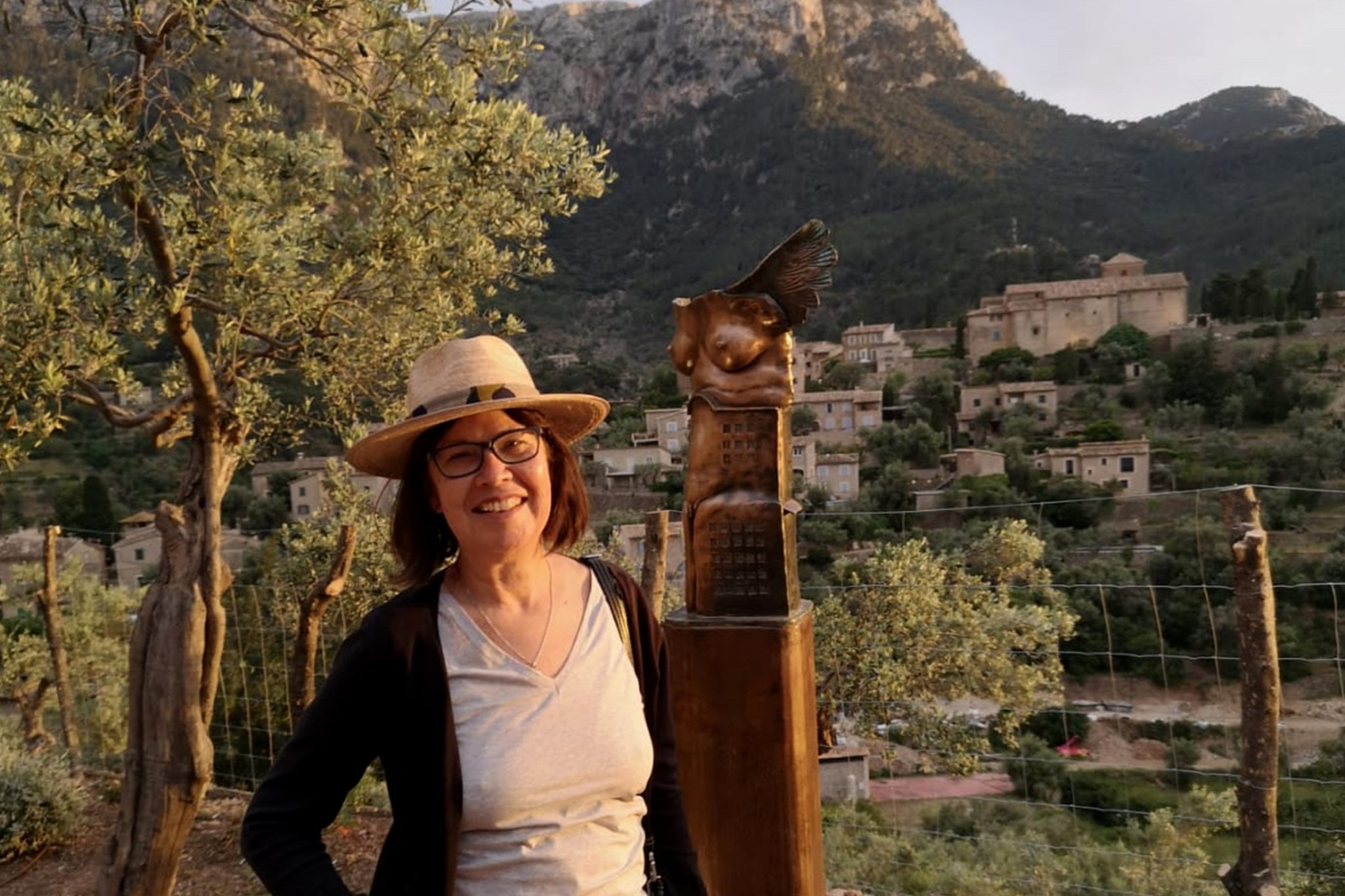
For Gina Vasquez, Mallorca wasn’t just a place on the map — it was the end point of a winding, transatlantic journey that began in Southern California and moved through Madrid’s creative scene before settling on the island. Along the way, she shifted from fine arts to advertising, then from publishing to tourism, finally becoming an official guide of the Balearic Islands in 2023. Today she runs Visit My Mallorca, designing tailored itineraries for clients — mostly from the United States — who are eager to understand the island’s culture, food, history, crafts, and increasingly, its housing market.
Speaking to Humans of Mallorca, Gina shares how her early curiosity for foreign places, her creative background, and the twists of family life converged into a career she never planned but clearly loves.
Where did you grow up and what were your early interests?
I was born in Santa Ana in Southern California, which has a Mediterranean climate similar to Mallorca — just less humidity. I studied Fine Art & Design at UCLA after realising that marine biology wasn’t going to work out: the maths got in the way! Back then, graphic design was still very hands-on when I started working from my studio in Santa Monica.
As a child, I don’t remember having a clear idea of what I wanted to be, but I do remember wanting to travel. I couldn’t imagine living my entire life going up and down the same streets. I once thought about becoming a travel agent but back then it meant sitting in an office surrounded by brochures, which didn’t appeal. My family background also shaped me: my grandparents emigrated from Mexico, my mother was a homemaker, and my father worked for McDonnell Douglas. Spanish wasn’t spoken at home, so I only started learning the language in high school. I got good grades but still couldn’t speak it. That was one of the reasons I wanted to come to Spain.
How did Spain enter the picture?
Through Juan, who later became my husband. He had worked as a creative director at one of the early Hispanic ad agencies in Los Angeles and had two sons living in Mallorca. When we met, he was ready to return to Spain. We married in Venice Beach, and two weeks later I was in Madrid having lunch with my new family. We lived in Madrid for six years and I loved it, but when our son Ian was one year old, we decided to move to Mallorca. My mother-in-law lived here, so we visited regularly. We settled on the island in 1994 and our second son, Teo, was born in Palma in 1996.
What were your early professional years like in Spain?
In Palma we had a boutique ad agency, Waelder Mallorca, which connected us with people across Mallorcan society — politicians, sports figures, bankers, business owners. We also published Mallorca Golf&Go!, a culture-and-golf magazine distributed in Mallorca and mainland Spain. It was fun while it lasted.
When we closed the agency in 2011, I wondered what to do next. I came across a Canadian online travel agency looking for local guides and thought, “I can do that!” I gathered a few recommendations, was interviewed, and was accepted. With the contacts I’d made, I developed a few tours and soon had a steady stream of clients. A few years later, I created Visit My Mallorca, expanding into full itineraries, reservations, transport, and activities.
Most of my work now comes from North American travel agencies, Destination Management Companies and five-star hotels, though I also receive direct requests through my website. During Covid, I used the downtime to study for the official tour-guide qualification — a two-year process. Since 2023, I’m an official tour guide of the Balearic Islands.
What challenges did you face when you first arrived?
After loving city life in Madrid, the move to suburban Mallorca was a big change. I was at home with two small children, and our world revolved around school, the beach, after-school sports, and the Rei Jaume fiestas in Calvià.
The hardest part of moving from the US had actually come earlier: dismantling two households while organising a wedding. We held multiple yard sales and managed to sell or give away almost everything. The move from Madrid was easier.
What do people in the USA know about Mallorca?
With almost all my clients coming from the US, I hear a wide range of comments. Many cruise passengers haven’t done much research and are surprised to learn how large the island is — some don’t even realise they’re on an island. Others are shocked by the size of the airport, the crowds, and the traffic.
But almost always, they ask about the cost of housing and the best places to live. They want to know about the winter weather, safety, and why locals seem less stressed. They love the fresh food, the variety of produce, and the lack of additives. Many comment on Spain’s universal healthcare.
North Americans particularly enjoy artisan workshops. They love the idea of supporting the local economy. They’re not coming all this way for the beach; they want history, culture, food, and wine.
What surprised you about Mallorca when you first arrived?
Two things: discovering that Junípero Serra was born here — he’s central to California’s history — and realising how car-dependent the island is. After Madrid’s excellent public transport, Mallorca’s system felt limited. It has improved, but a train from the Andratx or Calvià area to Palma would make a huge difference.
Tell us about your community here.
Years ago a few of us started the American Women’s Club. At our first lunch, sixty women showed up. Many were retired military or women who had married Mallorcans and wanted to reconnect with American culture. The group eventually faded, but the need didn’t: the Facebook group I now run, Americans on Mallorca, has 1,900 members with endless questions about life here. There are many people from the USA coming into Spain and many have their eyes on Mallorca. There was a time when one rarely heard a US accent. Now I hear it constantly.
What makes Mallorca special compared to other places you’ve lived?
It’s a wonderful place to raise children. It reminds me of my own childhood — sending the kids out to play in the morning and calling them home at lunch. My sons spent their days roaming the countryside with friends.
What are your plans?
I’m always studying and reading to become a better guide. I also meet new providers to design new routes. In winter I often take local history classes and try to travel. From Palma, most European capitals are only two or three hours away, so Europe feels wide open.
And your long-term goal?
I love what I do. My goal is simply to keep doing it for as long as possible.






