
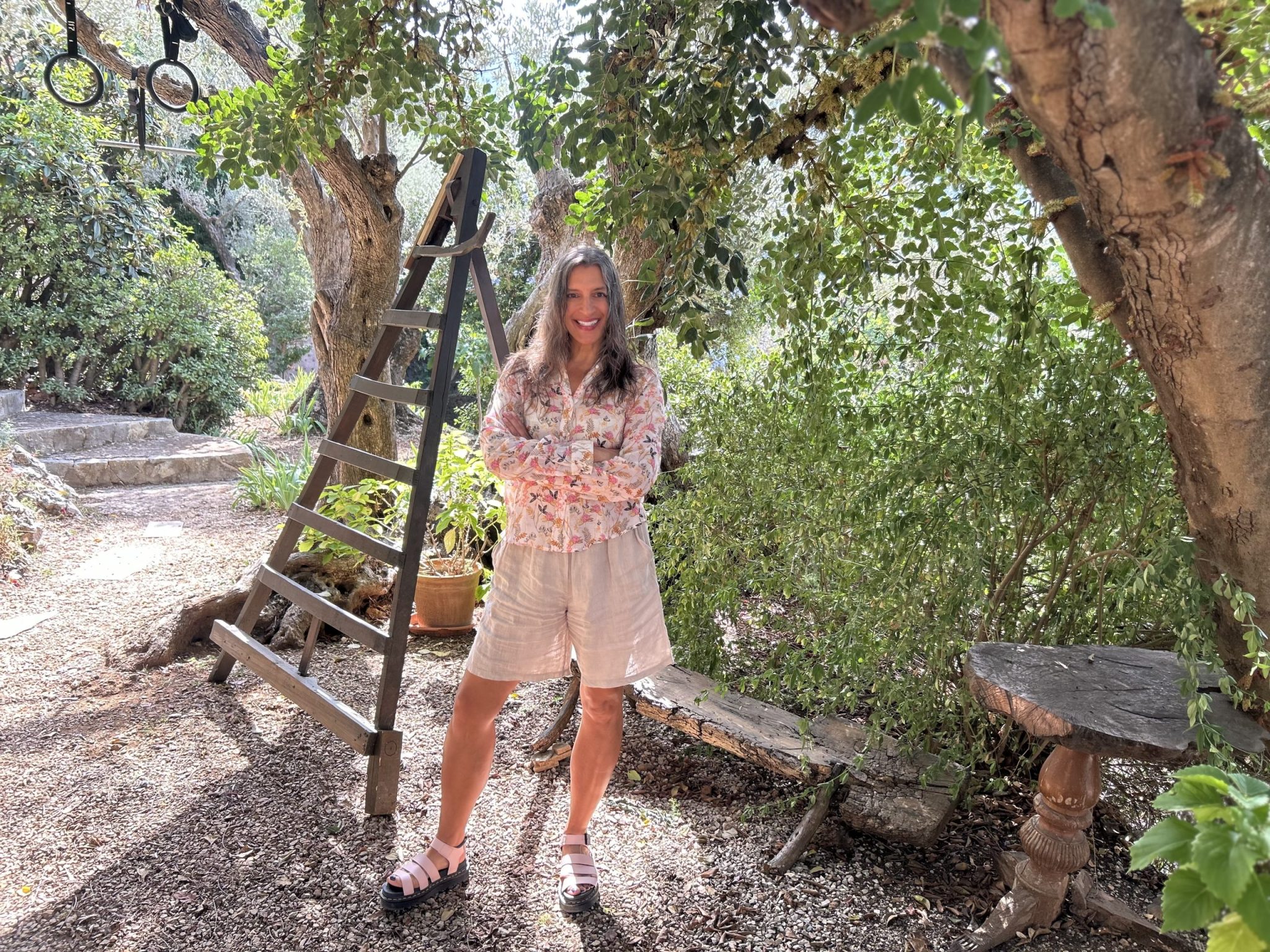
“Everyone’s story is interesting,” says Tara Huber. “I just try to give people the platform to really express who they are.” That belief has become the beating heart of Deià Unpacked, the podcast she launched from her home in Mallorca’s Tramuntana mountains at the height of the pandemic lockdown. Since then, the New Yorker-turned-Deiànenca has interviewed artists, musicians, writers, restaurateurs and lifelong locals — anyone with a connection to the village she now calls home. What has she learned along the way? That behind every postcard view of Mallorca lies a community of people quietly shaping its spirit. We spoke about her life between Brooklyn and the Balearics, her fascination with local stories, and the strange magic of small places that feel larger than life.
How would you describe the people of Deià?
They’re incredibly open-minded and accepting. Anything goes here. It’s a place that nurtures exploration and artistic curiosity. There is a delightful mixture of eccentric personalities, mixed with some multi-generational Mallorcans that creates an enchanting vibe. One of the best things about Deià, is that everyone in Deià watches out for everyone in Deià. The average individual in Deià is also exceptional at walking uphill. The landscape of Deià is challenging, and it takes a special kind of determination to navigate it on a regular basis.
You’ve said, “If Deià is Manhattan, Sóller is Brooklyn.” What do you mean by that?
I always think of Sóller as Deià’s sister town — even more traditional and Mallorcan. I love Sóller because it has really held onto its roots. There’s an unnamed closeness between the two: many families have relatives in both villages, and the connection runs deep. So yes, Sóller is Brooklyn! Coming from me, that’s a huge compliment! The people of Sóller take their time to trust you, but once they do, you’re in for life.
Tell us a bit about your own story — how did a Brooklyn girl end up in the Tramuntana?
I’ve been coming to Deià since 1989. My husband actually grew up here, though I’d never heard of the village before meeting him. For years we’d spend summers here, but it wasn’t until the Covid lockdown that we made it our base. That’s when I started creating a real life for myself here, not just a vacation life.
I was born in Brooklyn and studied in New York and Illinois. I spent over two decades working as a personal trainer in Washington, DC, which I loved. Fitness has always been a huge part of my life — I enjoy helping people feel strong and confident. But the move to Mallorca gave me space to start something new creatively.
And that’s when Deià Unpacked began?
Exactly. During the winter of 2020, when everything slowed down, I finally had time to focus on a project I’d been dreaming about. I’d always wanted to create a podcast. Small talk and puffy sound bites don’t offer much, but nothing is better than putting on your earphones while cooking dinner and listening to a solid conversation. I knew it would be a lot of work, and I thought nobody would listen to it, but the timing was right. The first ten pilot episodes came out in summer 2021, and to my surprise it was really well received. We’re now heading into our fifth year, and the audience keeps growing.
What makes Deià Unpacked different from other local podcasts?
The concept is to have long format conversations with the wonderful people who live and visit the island of Mallorca. Everyone’s story and worldview are fascinating, and I enjoy giving people a platform to really express who they are. It’s incredible how interesting people are when they feel comfortable enough to let their hair down and get into authentic conversations. I always love going back to each talk when I’m editing and remembering the fun I had with each guest. Everyone’s story is interesting.
What is life in Deià like away from the postcards?
Life in Deià is lovely. It is a real community of people who live here every day, year-round, who are very committed to their lives here. It is so much more than a box to check on a tourist’s itinerary. There’s an incredibly creative community — and they like to party! Local fiestas and traditions are also typical here, and you’ll often find people of all ages mixing and partying together. For me, living in Deià means time in nature everyday either in the sea or up in the mountains.
You’ve spent time in other parts of Mallorca too. How do places like Valldemossa or Palma compare?
Valldemossa is elegant and stunningly pretty. Historically it was the town in the Serra Tramuntana where the Mallorcan nobility lived, and the Catholic Church flexed its muscle. There is a long and old rivalry between Deià and Valldemossa with a great story about Deià ’s eventual independence. Enchanting and magical, with fantastic history, Valledemossa is self-contained and enigmatic. The people of Valldemossa are nothing but a class act, with a series of highly cultured residents who also happen to be incredible artists.
Palma, meanwhile, is the jewel in the crown of this island. It’s sophisticated without being snobby — full of smart, funny, international people who love their city. They’ll happily drive into the Serra Tramuntana for the weekend, but they’re just as happy to come back to where all the good coffee and culture are.
You’ve built a life that blends work, nature and community. What does an ordinary day look like for you?
I’m an early riser — coffee, sunlight, dogs, and a quick garden check are my morning rituals. I work out with my husband every day; we design our own strength programmes, which we call our “secret sauce.”
When I’m in podcasting mode, I usually start around 11 a.m. and spend most of the day interviewing or editing. The rest of the time I try to get outdoors — a hike, a long swim, maybe kayaking. Dinner is usually homemade, and evenings are for reading or watching something in Spanish.
You’ve lived through some difficult times too — how have those shaped you?
Losing my mother suddenly when I was 35 was the hardest thing I’ve ever experienced. My twin boys were only seven, and I had to keep going for them. That’s what pulled me through — showing up for them every day.
That loss taught me to love people fully, every single day, because life is short and unpredictable. It’s made me softer and stronger at the same time.
What do you love most about Mallorca?
As much as I’m a city girl, I love nature and spending a lot of time out in nature. Mallorca gives me the best of this. Surrounded by mountains and the sea, I am either kayaking, swimming or hiking. For me, that’s a lifestyle that can’t be beat, as long as I get a few good city fixes a year. Though I have also lived in gorgeous natural areas in the states, including Montana, there is something entirely different and special living near the sea.
What’s your goal in life?
To keep changing and growing, and to never peak. I see each age and each time in my life as a time to improve myself and learn more. I always live my life like I’m just beginning. I also really hope to be a grandmother one of these days!
What do you think about the protests against mass tourism in Mallorca?
I’m not surprised. I completely empathize with the people of Mallorca and their frustrations. The low wages, plus the overcrowded conditions, plus burgeoning costs of living are a deep and understandable source of frustration. But I don’t blame the tourists, it’s not their fault. It’s a lack of proper governance that creates this mess. Something really does need to change. I believe that it will get better for locals, it’s the only way to hold onto that thing that makes Mallorca so special.
And how do you see Mallorca’s future — say in 2040?
I’m optimistic. By 2040, I think Mallorca will be the best version of itself. It will have figured out how to strike the right balance between tourism and other industries that support thriving, multi-generational communities. I’d like to see the island hold on to the things that make this island so special, while supporting the people who live here. We all owe it to future generations to figure this out and help this island live up to its potential.
And what else?
I’m very excited about a new initiative that I’m working on called Regenera Deià, I envision it having a positive impact on Deià and potentially the Balearic Islands as we move into the future.






