
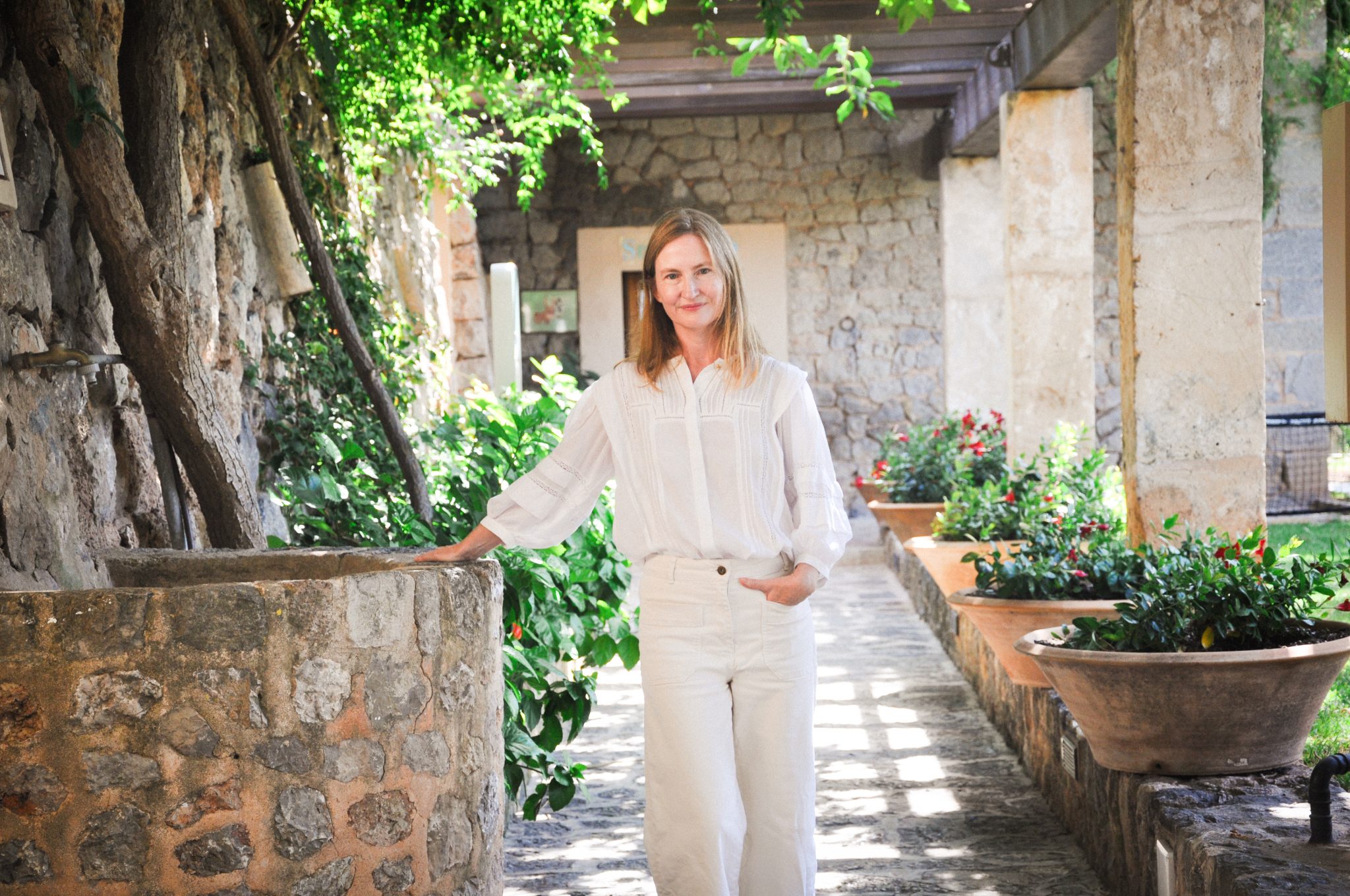
Rock stars in the spare room, nudes in the living room, and a bohemian childhood in Deià — Amy Sheridan grew up in the thick of it all. Today she oversees Sa Tafona, the legendary gallery founded by her parents, carrying its spirit into a new era.
Growing up in Deià in the 1980s meant being surrounded by one of Mallorca’s most unusual communities — a mountain village where painters, poets, musicians and bohemians rubbed shoulders in bars, studios and borrowed living rooms. For Amy Sheridan, childhood meant stray cats hidden in closets, nude models posing in the family’s sitting room during impromptu life-drawing sessions, and the occasional rock star drifting through the house. Eric Burdon of The Animals once stayed over; other guests were equally colourful, part of the creative tide that washed through the Tramuntana. At the centre of it all were Amy’s parents, artists Cecilie and George Sheridan, who in 1984 founded Sa Tafona gallery at La Residencia hotel — not for profit, but to give a platform to art and artists. Four decades later, Amy carries that legacy forward. Yet her path back to Deià was anything but straightforward: after careers as a veterinarian and scientific translator, she eventually took over Sa Tafona, which she now runs while raising two sons. In this conversation, Amy reflects on her extraordinary upbringing, the reinventions that shaped her, and why she believes change always leads to new opportunities.
Where were you born, and what do you remember most about your early years?
I was born in London, although my parents moved to Mallorca when I was a baby. My childhood in Deià was happy and free. With two artists as parents and an older sister, I grew up in a small village where children roamed safely, without television until I was eleven. I spent my time reading, playing outside, or secretly rescuing stray cats. My father was allergic, so I wasn’t supposed to keep one, but once I hid a kitten in my closet for weeks. My mother knew but pretended not to until the meowing gave it away.
What was it like having artists and musicians constantly around?
Colourful, to say the least. Many of my parents’ friends were eccentric artists and writers, and dinners often turned into wild late-night parties. They also held life-drawing sessions at home, so I was shy about bringing friends over in case we walked into a nude model in the living room. Once Eric Burdon of The Animals stayed at our house — my sister and I snooped in his room and found the floor covered in used… erm, not socks.
Did you always imagine following your parents into art?
No. From an early age I wanted to be a vet, partly to rebel against my father. He wanted me to cultivate my mind, but he wasn’t keen on me dealing with blood and disease, which only made me more determined. I studied veterinary medicine in Barcelona and Madrid, but the reality was tough: long hours, low pay, and mostly dealing with owners rather than animals. Many of my classmates left the profession, and I did too.
And then you became a translator?
Yes. I’d already been proofreading scientific articles, so translation was a natural next step. It allowed me to move abroad when my partner found work elsewhere, though the reality was solitary and full of relentless deadlines. Once my sons were born, I didn’t want to go back to it.
How did you return to Sa Tafona?
The gallery was always part of my life. My parents opened it in 1984, the same year La Residencia began, and I grew up surrounded by it. Eventually I took over, determined to preserve their vision while making it my own. Now, of course with the help and support of my family, I manage everything: planning the exhibitions, visiting artists, supervising installations, and caring for more than 800 works we loan to the hotel. No two days are ever the same.
What does the gallery represent to you today?
It was unusual when it started — a gallery run altruistically, never taking commissions, often buying works themselves. That helped sustain the art scene and build an extraordinary collection that reflects decades of Deià’s history. I try to continue that spirit. Sometimes I find artists, sometimes they find me. Social media has made the gallery much more visible and we now receive ten times as many requests. I aim to balance established and younger artists, and to keep a connection to Deià while bringing in new voices. My mother, now 87, still has a great eye and even hosts weekly art tours in her home, but she’s happy to let me lead.
Sa Tafona openings are legendary. What are they like?
The gallery’s exhibitions run throughout the hotel season, and the openings often attract hundreds of people — artists, collectors, politicians, celebrities and art lovers from across Mallorca and beyond. That sense of community, of keeping Deià on the map as a living art centre, is what makes Sa Tafona so special.
How do you approach curating?
The opposite of translation — I’m out meeting people, visiting studios, and curating shows. Group exhibitions can be tricky because everyone wants the best spots, so it requires diplomacy, but I love it.
How do you define success?
Not in money or followers, but in doing what you love. I’ve had three very different careers, and each allowed me to pursue passions. It’s never too late to reinvent yourself.
What’s the hardest part now?
I’d say the biggest difficulty for me now is trying to find the right life-work balance. Being a single mother with primary physical custody of my two children leaves me little time for anything else. I end up having to spend most of my weekends or nights after my children have gone to sleep catching up with work and other things. It can be quite taxing, especially when you don’t sleep much!
You’ve also faced some very serious personal challenges.
In my early thirties I had two ectopic pregnancies less than a year apart. The second nearly killed me — I suffered severe internal haemorrhaging, drifting in and out of consciousness, and was already in hypovolemic shock by the time I got to hospital. Blood donors and surgeons saved my life. It took a long time to recover, physically and emotionally, and I was told to stop trying for children. But I ignored the advice, and today I have two wonderful sons. My marriage didn’t survive. Divorce was a long, draining process, but I feel I’m finally where I should be.
How did you get through it?
With a lot of support. One friend called me every day for almost two years, and writing also helped. I began working on a memoir, which gave me clarity and was deeply therapeutic.
What did you learn about yourself?
That I’m stronger than I thought. I used to put others’ needs first; now I’m more protective of my wellbeing. I like challenges and I don’t give up easily. Change doesn’t frighten me — it leads to opportunity.
What are you most proud of today?
My children. Hours in the car driving them to school mean we have wonderful conversations. They amaze me with how they think about the world — though they do tell me my music is outdated and beg me not to sing along!
Mallorca is in the spotlight with protests against mass tourism. What’s your view?
The protests are inevitable. The island has reached a breaking point, with pressure on resources like water and housing and huge environmental impacts. The seas are crowded with boats, damaging the Posidonia meadows — the lungs of the Mediterranean. Tourism is essential, but both its quantity and quality need to be addressed.
Do you still enjoy travelling yourself?
Yes, though I feel guilty about the environmental cost of flying. But living on an island brings “island fever,” and I can’t resist discovering new places.
And the Tramuntana mountains — what do they mean to you?
They’re omnipresent, towering above the village like a protective wall. In winter the sun only clears the ridge for a couple of hours a day, which can feel oppressive but also like a shield from the outside world. Whenever I drive back home up the mountain, I feel a weight lift. Even if you’re not a hiker — and I’m not — living in Deià gives you a special relationship with the Tramuntana.
Looking ahead, what do you think Mallorca will be like in 2040?
I try to think of the future in a positive way. I hope this place that has been my home for most of my life will still be a wonderful place to live, but it has already changed so much since I was young — not always for the better. My children, like many young people now, often suffer eco-anxiety. They ask how it will be if summers keep getting hotter and water becomes scarcer, or how we’ll manage to afford living here as prices rise.
For Mallorca to remain a corner of paradise, many changes need to happen. The problem is that change at a political or social level tends to be slow — climate activists have been sounding the alarm since the 1970s. Still, I’m hopeful. Change needs to happen on a broad global level, but there is also a lot that can be done individually or as a community.






