
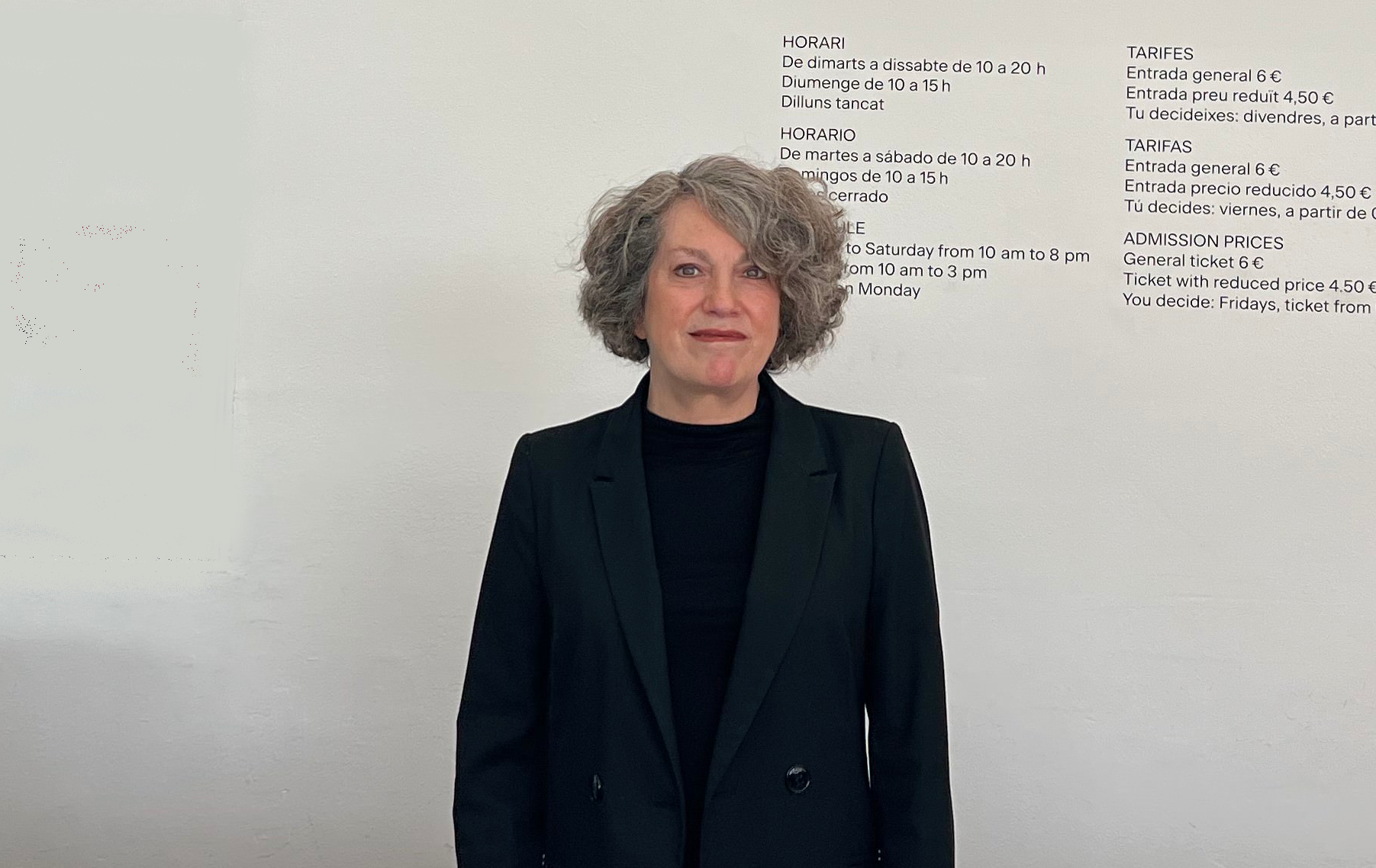
Maria Gayà understands the quiet power of a warm welcome. As the first person visitors encounter at Es Baluard museum of modern and contemporary art, she sets the tone for their experience — not just by handing out tickets, but by making people feel seen. “I always try to treat visitors the way I’d want to be treated,” she says. Stationed at the museum’s front desk, she is the gateway between the outside world and Mallorca’s vital art space. Whether it’s a seasoned art lover or someone visiting a museum for the first time, Maria ensures their journey begins with a personal connection. Fluent in seven languages, she greets guests in their own tongue, offering a sense of belonging before they even step into the galleries.
Maria’s path to Es Baluard was anything but planned. Before the museum even existed, she worked as a seasonal hotel receptionist, registering at the employment office at the end of each tourist season and waiting for the next opportunity. One winter, she was sent for an interview at the newly opened museum. She walked in, introduced herself, and never left.
“I’ve always appreciated art and culture,” Maria says. “Even before working here, I regularly visited museums and galleries.” In hindsight, it seems like it was always meant to be.
“I Learned to Say ‘Thank You’ in 45 Languages”
Maria has a talent for making connections. A natural polyglot, she speaks Catalan and Spanish fluently and is conversational in French, English, German, Italian, and Russian. But her language skills weren’t acquired in a classroom; she learned through real-life interactions with visitors from around the world.
“I wouldn’t say I’m perfect in any of them,” she says. “But I manage.”
She first studied French at school and refined it at the Alliance Française. In tourism school, she took English and French, but her first job in a hotel immersed her in German. She started by memorizing numbers and quickly built her skills through daily conversations with guests. Later, at Es Baluard, she enrolled in an official language school to study Russian and Italian, eager to bridge even more cultural gaps.
What truly sets Maria apart is her approach to learning languages. She has a simple trick: whenever she meets someone who speaks a language she doesn’t know, she asks, “How do you say ‘thank you’ in your language?” Over the years, she’s collected thank-yous in 45 different languages.
“One time, a visitor from Pakistan was so delighted that he asked to take a photo with me,” she recalls. “And another time, two Russian visitors were so excited that they gave me their email addresses so we could keep practicing Russian together.”
The Art of the First Impression
For some, Es Baluard might be their first museum visit In Mallorca, and Maria understands the importance of that first moment. She takes the time to explain the exhibitions, offering just enough context to spark curiosity.
“I don’t know exactly what impact that has,” she says. “But I do know that a smile and a warm welcome can make a difference.”
One of her proudest moments at Es Baluard had nothing to do with selling tickets. While learning Russian, she was asked to lead a class. Instead of a traditional lesson, she decided to take her classmates and teachers on a guided tour of the museum, entirely in Russian.
“It was a challenge,” she admits. “But it was also incredibly rewarding. Beyond that, the most rewarding part is feeling valued, both by my colleagues and by the museum’s Friends association.”
Other moments of appreciation come in unexpected ways. On Fridays, Es Baluard allows visitors to choose their own ticket price under the “pay what you can” policy. Many give what they can, but some are so moved by their experience that they return on their way out to donate even more.
Maria sees her role as intertwined with the art around her. “Practicality and creativity can go hand in hand,” she says. “I love working in this environment. Being surrounded by art and culture every day feels natural to me.”
For many visitors, a trip to a museum can feel impersonal. Ultimately, Maria offers something different — a human touch.
“People don’t always realize how important small gestures are,” she says. “Respect goes a long way. When you treat people with kindness, they usually return it.”
What she hopes visitors take away from Es Baluard isn’t just the memory of an exhibition, but the feeling of being welcomed. Because in the end, a museum isn’t just about the art on its walls— it’s about the people who bring it to life.
Do you have an extraordinary story to share? Whether you’re making waves in sports, music, art, business, or another field, we want to hear from you! Become a Human of Mallorca and let us share your journey with the world. Get in touch with us at: hola@humansofmallorca.com






