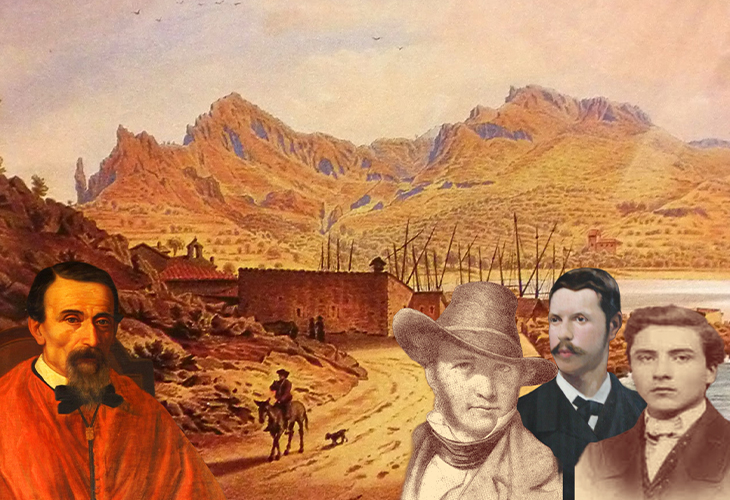
Long before hikers traced the GR221 or families queued for a gelat in the Plaça on their way to the Port, Sóller was quietly casting its spell on the first European travellers. They arrived in a gentle trickle — romantics, aristocrats and assorted eccentrics armed with notebooks, sharp eyes and a thirst for the exotic — and they wrote about what they found with open-mouthed astonishment.
Because what they found was extraordinary: a valley ringed by mountains so dramatic they look staged, and a way of life far removed from their own. These weren’t tourists in any modern sense but explorers, scholars, artists and, occasionally, spies — a colourful cast whose writings helped lift Sóller out of obscurity.
These visitors didn’t just jot down their impressions; they helped invent Sóller’s reputation. Their letters, sketches, travelogues, and occasionally comical misadventures were the first pieces of tourism marketing in the history of the valley — accidentally launching Sóller into the European imagination.
What follows is the story of these early travellers, their astonishment, their prejudices, their near arrests (yes, really), and the valley that bewitched them all.
When the valley was still a secret
The tale begins in the late 1700s, when only wealthy Europeans had the luxury of travelling “for pleasure.” Most arrived with an academic pretext — geography, economics, botany — but what they really wanted was to report on the exotic customs of the islanders and the mythical beauty whispered about in elite salons.
One of the earliest was José de Vargas Ponce, a naval officer and scholar who visited Mallorca in 1784. His 1787 book, Descripciones de las islas Pithiusas y Baleares, is now considered one of the founding texts of Mallorcan tourism. When he reached Sóller, he was floored:
“The delicious Valley of Sóller… appears as a confused forest of trees, though examined closely it reveals that everything that seems confusion is in fact order,” he wrote admiringly. The town was “the most beautiful and richest of the entire island,” its agriculture so fertile that locals treated every piece of land as “a mine of inexhaustible wealth”. The houses, “while neither large nor magnificent, were proper and decent”.
Already, Sóller was receiving rave reviews.
A few years later, Jeroni de Berard, a Mallorcan military officer and illustrator, published Viaje a las villas de Mallorca (1789) — a remarkably modern travel guide complete with maps. From him we get a wonderfully practical early review of the port, describing the challenging winds and the attempt to build a new jetty funded by a tax on orange cargoes. Yes: even in 1789, oranges were paying for infrastructure.
The 19th century: Sóller goes viral (slowly, in book form)
By the 1800s, Mallorca saw a steady trickle of curious foreigners. They came seeking mild winters, picturesque villages, folkloric authenticity, and occasionally strategic information (Napoleon sent at least one spy disguised as a man of letters).
A climate worth writing home about
One such visitor (and likely spy) was André Grasset de Saint-Sauveur, who arrived around 1800 and described the climate in promotional terms any modern tourism board would envy:
“The climate of Mallorca is temperate… In summer, fresh sea winds moderate the heat… the mountains protect the island from the north,” he wrote in 1807.
This was catnip to wealthy northern Europeans needing an excuse to winter somewhere that didn’t involve frostbite.
His take on Sóller? Beautiful, yes — but tragically underexploited:
“One leaves lamenting that the islanders do not make better use of it,” he sniffed.
The tone — part admiration, part condescension — is typical of the era.
Artists, romantics, and the man arrested for sketching the port
If one figure embodies the romantic, slightly melodramatic style of 19th-century travel writing, it’s Jean-Joseph Bonaventure Laurens, a French artist and friend of George Sand and Chopin. Visiting in the 1830s, he adored the landscapes… but had a less serene encounter in Port Sóller.
Laurens sat down to sketch the local fort when suddenly:
“Four individuals threw themselves upon me… I had committed the crime of drawing a fortress, prohibited by the laws of the kingdom,” he wrote. He spent three hours detained by a man he nicknamed “Six-fingers” (Seis-dedos), before being rescued by Sóller’s French consul.
The first documented case of “Mallorca: come for the scenery, stay for the bureaucratic misunderstandings.”
One valley, infinite orange trees
Through the 19th century, the orange groves became Sóller’s calling card. Travellers wrote about them in tones usually reserved for religious visions.
The Polish writer Charles Dembowski, who visited during the Carlist War of the late 1830s, marvelled that Sóller exported more than 100,000 escudos worth of oranges to France each year:
“Calculate these oranges at one franc each and you could cover the entire Republic of San Marino with them,” he joked.
A Catalan landowner, Josep Antoni Cabanyes, provided one of the most beloved early descriptions of the valley:
The valley, he wrote, was like “the bottom of an immense cauldron” whose fertile soil had washed down from the mountains over centuries. The orange trees formed such thick canopies that “not a single ray of sun” reached the ground beneath them.
The marketing practically wrote itself.
The dramatic arrival and first view
If the valley dazzled visitors, the sublime descent into it astonished them even more. In 1840, the Mallorcan scholar Antoni Furió described reaching Sóller via the Coll (the old winding road before the tunnel existed):
“After ascending a steep slope… a magnificent spectacle appears. Gigantic mountains… a deep and terrifying valley… and then, suddenly, the traveller slides down into the Garden of the Hesperides,” he wrote, comparing Sóller to the mythical orchard of golden apples.
The fact that multiple 19th-century writers compared Sóller to Greek mythology gives an idea of how intoxicating the first sight of the valley was.
Not all reviews were 5 stars
Not every visitor was charmed. In 1845, Catalan writer Joan Cortada i Sala, usually a defender of Mallorca and its people, arrived in Sóller and fell victim to… a miserable experience at the inn. The beds were unmade, the grumpy landlady failed to greet them, and a greasy lamp hanging from the shutters sealed the deal:
“These are bad antecedents,” he grumbled, “and when the antecedents are bad, what follows is rarely good”.
Even in the 1840s, Sóller’s hospitality industry had its learning curve.
The archduke who became Sóller’s biggest fan
The most influential promoter of Sóller (and of Mallorca in general) arrived in 1867: Archduke Ludwig Salvator of Austria, a Habsburg prince with the soul of an ecologist and the budget of, well, a Habsburg.
For decades he lived, hiked, researched, and wrote obsessively about the Balearics. His monumental Die Balearen — seven volumes — contains lyrical, almost lovesick passages about Sóller:
“Without doubt, the most beautiful town on the island… one of the most beautiful in the world,” he declared. The valley’s fertility, fragrance of orange blossom, abundant water, and the “cordiality and simplicity of its inhabitants” made it, in his words, an ideal place to settle forever.
This was perhaps the most glowing review Sóller had received in its entire history — and it came from royalty.
Late-century visitors: sketchbooks, scepticism, and sunset walks
By the 1880s, travellers were arriving armed with sketchbooks and proto-cameras. The English writer Charles William Wood described Sóller as “picturesque,” though he noted the inhabitants appeared “pale” and “lacking in vigour,” attributing this to the valley’s dramatic enclosure by mountains. “There’s something sad and depressing in Sóller,” he wrote. Still, he loved sitting on its bridges, sketching shaded courtyards, and listening to the sound of looms inside workshops.
Another artist, Gaston Vuillier, visiting in the 1890s, was captivated by the traditional clothing of Sóller’s people, likening the men to modern Greeks and praising the beauty and calm poise of local women.
A German naturalist, Hermann Pagenstecher, described arriving back in Sóller one moonlit night in the 1860s:
“The town, submerged among the dark foliage… the white houses scattered among the orchards… the nightingale’s notes drifting through the air,” he wrote, before praising the inn’s warm welcome and comforting dinner.
The valley had become a place of enchantment, melancholy, rural vitality, and rest.
A valley invents Its own legend
By the end of the 19th century, Sóller had built a reputation entirely through the pens and pencils of travellers. No official tourism board, no glossy brochures — just stories spreading across Europe:
These accounts — romantic, eccentric, sometimes grumpy, often extravagant — were Sóller’s first marketing campaign. And they worked. By the early 20th century, the valley had hotels, a bustling Port with steamers to Barcelona, France and the wider world, a railway line, and a tram.
Today, when visitors arrive by train or descend via the tunnel into the valley, they’re travelling in the footsteps of those first wide-eyed adventurers who couldn’t believe such a place existed. Two centuries later, Sóller still delivers the same surprise.